The new Profy piano study matters because it asks one of the most practical questions in music education: can AI help students find the exact parts of a performance that deserve the next round of practice? For piano students, the hard part is rarely knowing that something went wrong. The harder part is knowing where to listen again, what to repeat, and which few seconds of a recording reveal the real issue.
Profy, introduced in a June 2026 research paper by Kazuki Kawamura, Fujiki Nakamura, Hayato Nishioka, Momoko Shioki, Shinichi Furuya, and Jun Rekimoto, is not a magic piano teacher. It is a research system built to visualize time-localized differences between expert-like and amateur-like piano performance. Instead of giving a student one broad score after a take, Profy highlights passages that may deserve review.
That distinction matters for kaygranger.com readers because practice often fails when students repeat too much at once. A beginner may replay the whole piece from the beginning. An intermediate student may drill the flashiest passage while ignoring weaker timing elsewhere. A more advanced player may sense that something feels unconvincing but lack a clear way to inspect the recording. Profy suggests that future AI piano tools may help students move from general feedback to focused listening.
Why “Where To Practice” Is A Better Question Than “How Did I Score?”
Many piano apps already give students feedback on wrong notes, timing, streaks, and lesson completion. That can be useful, but score-based feedback has limits. A student can receive an 82 percent score and still not know which musical habit needs attention. Was the problem rhythm? Touch? articulation? uneven release? rushed timing? soft dynamics? unclear phrasing?
The Profy paper focuses on that gap. Its authors write that piano performance quality depends on nuanced timing, articulation, and dynamic control, while practice feedback is often summary-based and difficult to act on. The official Profy arXiv paper describes a weakly supervised system that learns from performance labels and creates time-aligned highlights for review during piano practice.
That is a meaningful shift for students. A single score can encourage comparison. A time-based highlight encourages investigation. Instead of asking, “Am I good or bad?” the student can ask, “What happens in this passage, and what should I hear differently?”
This connects naturally with kaygranger.com’s earlier AI piano teachers in 2026 coverage, where AI learning tools were framed as support systems rather than replacements for human instruction. Profy fits that cautious model. It does not claim to replace a teacher’s ear. It points toward a future where technology helps students locate the next useful practice target.
What The Profy Study Actually Tested
The Profy study used synchronized key-motion and audio data from 73 pianists and 1,083 valid takes. That matters because piano performance is not only sound. Key motion can reveal attack timing, release timing, articulation, and physical patterns that are difficult to understand from audio alone.
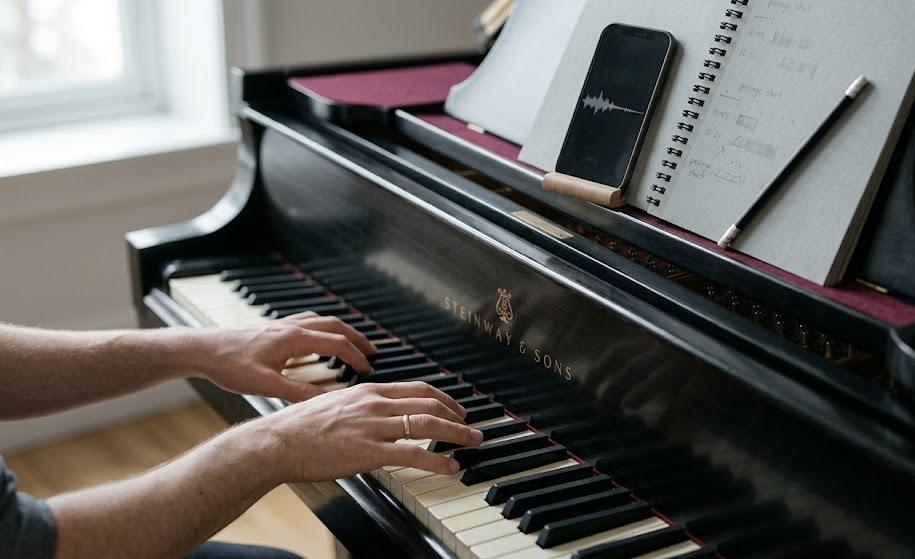
The system was trained using take-level labels, not detailed second-by-second teacher annotations. In simple terms, it learned from broader judgments about whether performances sounded more expert-like or amateur-like, then produced evidence scores across the performance timeline. Those scores were visualized so learners could scrub, loop, and replay the parts most associated with expert-amateur differences.
The evaluation is also worth reading carefully. The paper reports that, on 20 amateur clips from short technique studies annotated by 21 expert pianists, Profy’s displayed highlight score aligned with passages experts marked for review, with Pearson r=0.61 and ROC-AUC 0.75. Those are promising numbers for a research prototype, but they are not a guarantee that every student can upload any piece and receive perfect practice instructions.
Sony Computer Science Laboratories announced on June 22, 2026, that the paper by Jun Rekimoto, Shinichi Furuya, and collaborators was presented at ACM Designing Interactive Systems 2026 in Singapore. The Sony CSL conference notice frames the work around interpretable visualization of expertise-dependent motor skills for piano practice.
For piano teachers, the key word is interpretable. The system is not only judging a performance. It is trying to show why a passage deserves attention.
Why Highlighted Practice Could Help Students Stop Replaying Everything
One of the most common beginner and intermediate practice mistakes is starting from the beginning every time. The student makes one mistake near measure 28, returns to measure one, plays until measure 28, repeats the same mistake, and then starts again. That cycle feels like work, but it often wastes attention.
A system like Profy points toward a different habit. If the AI highlights a short section for review, the student can loop that section, compare takes, and listen for what changes. This makes practice smaller, sharper, and more evidence-based.
A good teacher already does this in person. They stop the student, isolate two bars, ask for slower playing, listen for the release, adjust the rhythm, or reshape the phrase. The challenge is that students do not always know how to repeat that process alone at home. A visualization tool can act like a practice map, showing where to inspect first.
The best use is not blind obedience. A student should not assume every highlighted moment is automatically wrong. The stronger practice routine is to treat the highlight as a question. Why did the system mark this moment? Is the rhythm unstable? Did the touch become heavy? Did the left hand overpower the right? Did the articulation change? Does the phrase lose shape?
That turns AI feedback into listening training. The student learns to connect a visual mark with an audible issue.
Why Teachers Should Stay In The Loop
Profy suggests a useful future, but it also shows why human teachers remain central. Piano performance is not only data. A passage can sound unusual because the pianist made an expressive choice. A tempo shift can be stylistically appropriate. A softer attack can be deliberate. A student may need physical technique guidance that a visual highlight alone cannot provide.
Teachers are needed to interpret the feedback. If a system repeatedly flags a transition, the teacher can decide whether the problem is rhythm, fingering, tension, memory, musical direction, or misunderstanding of style. The AI can help locate the area. The teacher explains the cause and gives the right practice method.
That distinction is important for families and adult learners. AI tools may become better at identifying likely practice zones, but students should avoid treating every output as musical truth. A tool trained on expert-amateur differences may be useful for finding suspicious moments, yet a teacher still knows the student’s age, goals, repertoire level, physical habits, and long-term development.
This is especially relevant for young students. A child who sees too many highlighted “problem” zones may feel discouraged. A teacher can frame the output more constructively: here are two places worth exploring today, not ten reasons to feel behind.
What Students Can Borrow From Profy Right Now
Most students do not have access to Profy as a daily consumer tool. That does not make the study useless. It points to a practice method students can start using immediately with a phone recording and a notebook.
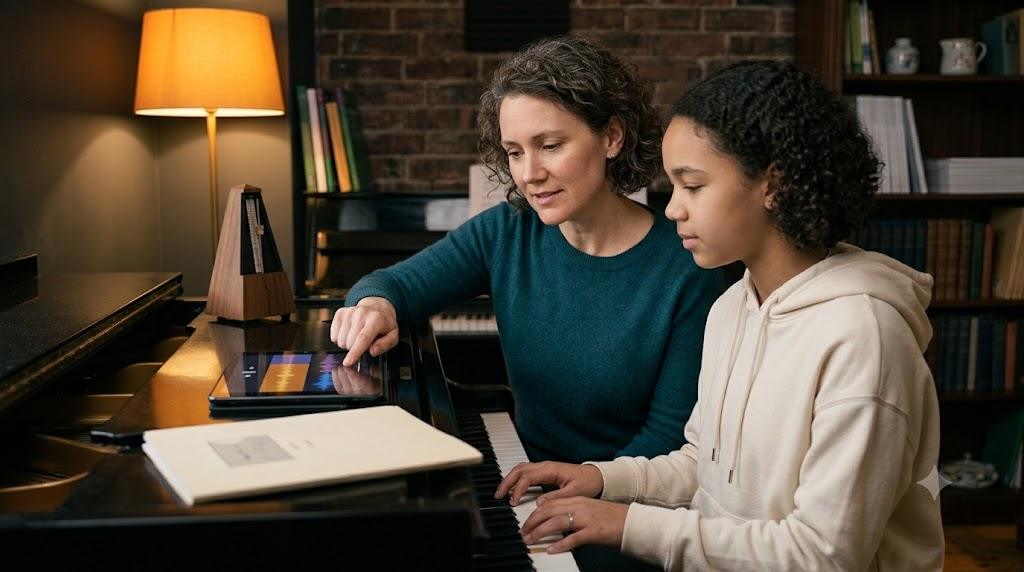
Record one short passage, not the entire piece. Listen once without playing. Mark the exact time where the performance feels weaker. Replay only that moment. Ask whether the issue is rhythm, tone, balance, articulation, or continuity. Then practice the smallest fixable unit at a slower tempo.
That process mirrors the logic behind Profy: move from whole-take judgment to time-localized review. A student does not need AI to begin thinking this way. AI may eventually make the process faster, but the musical habit is already available.
| Practice Habit | Old Pattern | Profy-Inspired Pattern |
|---|---|---|
| Recording Review | Listen once and judge the whole take | Mark a few seconds that deserve replay |
| Repetition | Start from the beginning again | Loop the smallest unstable passage |
| Feedback | Ask “Was it good?” | Ask “Where should I inspect next?” |
| Teacher Follow-Up | Bring a vague problem to the lesson | Bring one marked passage and a specific question |
This approach also helps students use future AI tools more intelligently. A student who already knows how to listen will get more value from AI feedback than a student who only follows colored markers on a screen.
Why The Study Matters For AI Piano Learning In 2026
AI piano learning is moving through an important phase. Early tools focused on access: video lessons, note recognition, progress badges, and basic timing feedback. Newer research is aiming at a more difficult goal: helping students understand performance quality.
Profy belongs to that second phase. It does not simply ask whether the right keys were pressed. It studies timing, articulation, dynamics, key motion, audio, and expert-amateur differences. That makes it more relevant to real piano practice, where two performances can use the same notes but communicate very different musical levels.
The limitation is that research progress is not the same as a finished teaching product. The study used short technique studies and a specific dataset. Real-world piano lessons involve wide repertoire, uneven recording environments, different instruments, varied student ages, and artistic interpretation. A useful future tool will need to explain its feedback clearly and avoid pretending that every musical decision can be reduced to a single mark.
Still, the direction is valuable. Piano students need help learning where to place attention. Teachers constantly tell students to listen more carefully, but listening is a skill. Visual highlights, looped review, and evidence-based feedback could give students a bridge between hearing “something is off” and knowing what to practice next.
Why The Best AI Feedback Should Make Students Better Listeners
The strongest lesson from Profy is not that AI can solve piano practice. It is that better feedback should make students better listeners. A good practice tool should not replace curiosity. It should sharpen it.
If an AI system can help a student find the five seconds where timing collapses, that is useful. If it can help a teacher show where articulation changes, that is useful. If it can guide a student away from replaying the entire piece and toward focused correction, that may save hours of unfocused work.
The danger comes when students treat the visualization as the music itself. A highlighted passage is not the final answer. It is an invitation to listen again. The student still has to slow down, test fingerings, shape sound, compare takes, and ask whether the performance became more convincing.
That is why Profy matters for piano education in 2026. It points toward AI tools that do not merely grade students, entertain them, or count practice minutes. It points toward tools that help students notice. For piano learning, noticing is the start of better practice.