Maggie Bai’s 2026 MostArts Festival Young Pianist Competition win gives young pianists a clear practice lesson: serious performance preparation cannot depend on long, unfocused sessions at the keyboard. Competition-ready playing needs focused practice blocks that train memory, technique, concerto awareness, sound control, and performance recovery as separate skills.
Alfred University announced on July 23, 2026, that Bai, a 15-year-old pianist from Newton, Massachusetts, won the 2026 Young Pianist Competition Grand Prize at the MostArts Festival Grand Finale Concert on Saturday, July 18. The award included $10,000 and an invitation to return to Alfred University in 2027 to perform during the opening night of the festival’s eleventh season. Bai was also listed as eligible to become a Young Steinway Artist.
For young pianists, parents, and teachers, the important point is not simply that a talented teenager won a major festival competition. It is that the MostArts format itself shows what serious preparation requires. The competition asked finalists to prepare solo recital repertoire, Mozart concerto movements, memory, and public performance readiness. That is too much for “practice more” to be useful advice.
Why MostArts 2026 Is A Practice Lesson
The official MostArts Young Pianist Competition page describes the event as open to high school pianists ages 13–18. Finalists perform a solo recital and solo with the MostArts Festival Orchestra during festival week. That format immediately changes the way a student has to practice.
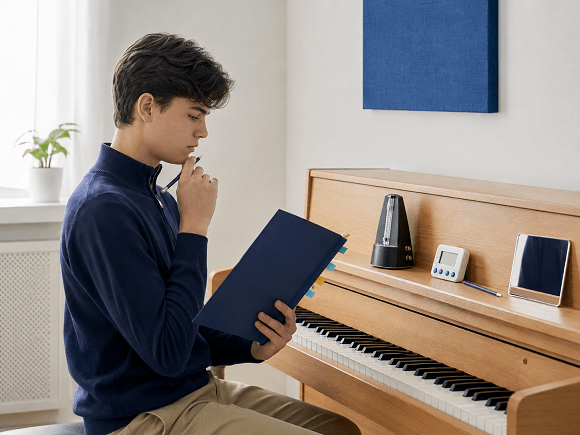
A young pianist preparing one short recital piece can often survive with a simple routine: learn the notes, repeat hard spots, memorize, and polish. A MostArts finalist has a more demanding problem. The student must handle solo repertoire and concerto repertoire. They must be ready for different rooms, different pianos, different kinds of pressure, and different musical roles.
That is why competition-ready practice blocks matter. A practice block is not just a chunk of time. It is a clear musical job. One block might repair a technical passage. Another might test memory from the middle. Another might practice a Mozart concerto entrance after silent counting. Another might simulate a no-stopping performance run.
Young pianists need this kind of structure because competition music is not one problem. It is many problems stacked together.
The MostArts Requirements Reward Organized Practice
The MostArts competition requirements explain why vague practice is not enough. Applicants had to submit video recordings of both solo recital repertoire and Mozart piano concerto movements. The required repertoire included the second and third movements of any Mozart Piano Concerto with cadenza if indicated, one virtuoso etude by Chopin, Liszt, Scriabin, or Rachmaninoff, and at least two contrasting solo works from different periods. The rules also stated that all music must be performed from memory for the preliminary and final rounds.
That is a serious workload for a teenage pianist. It requires more than endurance. It requires organization.
A student preparing that program has to ask different questions each day. Which section is technically unstable? Which passage is memorized only from the beginning? Which concerto entrance depends on the orchestra? Which etude passage becomes tense at tempo? Which solo work needs color instead of speed?
Without practice blocks, all of those questions blur together. The student may spend two hours playing from the beginning of pieces without solving the actual problems.
What Maggie Bai’s Win Shows About Readiness
Alfred’s announcement identified Bai as the first-prize winner and named the other 2026 honorees: William Feng, 14, of Seattle, won second prize; Daniel Beal, 18, of Moscow, Idaho, and Jeremy Liu, 14, of Naperville, Illinois, tied for third prize; Jeremy Liu and Bethany Reich received Audience Favorite Awards for Mozart concerto performances; and Alexander Liu received a Jury Discretionary Award for an encore performance of two Chopin mazurkas.
That winner list matters because it shows the competition was not built around one narrow skill. The awards recognized concerto playing, solo performance, audience response, and artistic discretion. A student preparing for this kind of environment needs to be flexible.
Bai’s win points to an important student habit: readiness is not the same as having played the piece many times. Readiness means the pianist can start from multiple places, recover after mistakes, listen under pressure, and make musical decisions even when adrenaline changes the body.
That is why competition-ready practice has to include more than note repetition.
A Better Practice Block System For Young Pianists
A strong practice plan should divide musical work by purpose. Young pianists do not need every block to be long. They need each block to be clear.
| Practice Block | Main Goal | Student Task |
|---|---|---|
| Technical Repair | Fix a specific passage | Slow rhythms, hands alone, small groups |
| Memory Starts | Build secure recall | Start from landmarks, not only the opening |
| Concerto Entrances | Prepare after orchestra cues | Count silent measures and enter cleanly |
| Sound Control | Shape tone and balance | Voice melody, lighten accompaniment |
| Run-Through | Test performance continuity | Play without stopping, then take notes |
| Recovery Review | Learn without overplaying | Listen, mark tomorrow’s fixes, rest |
This kind of routine protects attention. It also prevents the common mistake of spending all practice time on the most comfortable parts of the music.
Students can adapt this approach even if they are not preparing for MostArts. A beginner can use shorter blocks for rhythm, hands-separate practice, and review. An intermediate player can use blocks for scales, repertoire repair, sightreading, and recording. The same principle appears in kaygranger.com’s 10-minute piano practice routine: focused time works better than vague time.
Why Mozart Concerto Practice Needs Its Own Block
The MostArts 2026 preview said the concerto round would feature the second and third movements of Mozart concerti with the International Festival Orchestra under the direction of Steven Thomas. That detail matters because concerto practice is different from solo practice.
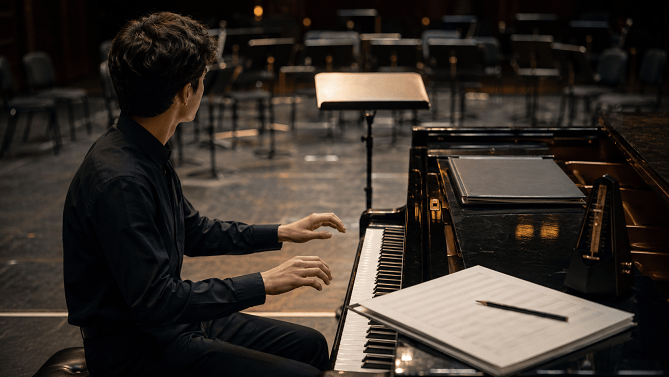
In solo music, the pianist controls the entire musical space. In concerto playing, the pianist must understand when the orchestra speaks, when the piano answers, and how the solo line fits into a larger conversation.
A Mozart concerto block might not involve playing a whole movement. It might involve counting silently before an entrance. It might focus on keeping left-hand patterns light. It might isolate a cadenza so the student knows its structure, not just its finger pattern. It might test whether the pianist can begin cleanly after imagining the orchestra’s final measure.
This is where young pianists often need teacher guidance. Mozart can look simpler than Romantic repertoire on the page, but its clarity exposes unevenness. Heavy accompaniment, rushed ornaments, unclear articulation, and tense scale work become obvious quickly.
A good Mozart block teaches the student to listen before playing.
Why Memory Practice Should Not Start At The Beginning
Competition rules that require memorization create a special practice challenge. Many young pianists memorize by repetition from the opening. That can work until something goes wrong. If the student only knows how to begin at measure one, a small slip in the middle can become a major collapse.
Memory blocks should train flexible recall. Students should mark structural landmarks: the start of a new section, a key change, a repeated theme, a cadenza, or a return of the opening idea. Then they should practice starting from those places.
This does not make the performance mechanical. It makes the performance safer. A pianist with multiple memory anchors can recover more calmly because the piece is mapped in the mind.
Teachers can help students test memory away from the piano too. A student can name the form, sing a bass line, tap the rhythm, or imagine the first measure of each section. These mental checks reduce dependence on muscle memory alone.
What Parents Should Understand About Competition Practice
Parents often measure seriousness by time. A three-hour session looks impressive. A 35-minute focused session may look too short. But competition preparation is not only about duration. It is about the quality of attention.
A young pianist who practices for three exhausted hours may simply repeat tension. A young pianist who completes three focused blocks may make more progress and stay healthier.
Parents can support better practice by asking better questions. Instead of “How long did you practice?” ask, “Which passage did you fix?” or “Where can you start from memory?” or “What did your recording reveal?” These questions help the student think like a musician.
Parents should also respect recovery. The night before a performance is not always the time for more full run-throughs. Sometimes the best work is mental review, quiet listening, light technical maintenance, and sleep.
What Teachers Can Take From MostArts 2026
Teachers can use the 2026 MostArts competition as a reminder to assign practice by function. “Practice your concerto” is too broad. “Practice three entrances after silent counting” is useful. “Work on memory” is vague. “Start from four marked landmarks without looking at the score” is measurable.
Teachers should also separate learning, repairing, polishing, and performing. A student who is still learning notes should not be judged as if they are performing. A student doing a run-through should not stop every two measures to fix details. Different blocks have different rules.
This structure gives students confidence because they know what success looks like in each session. They are not simply hoping the piece improves.
Why Competition-Ready Blocks Help Every Student
Most young pianists will not win a major competition. Many will never enter one. That does not make the lesson less useful.
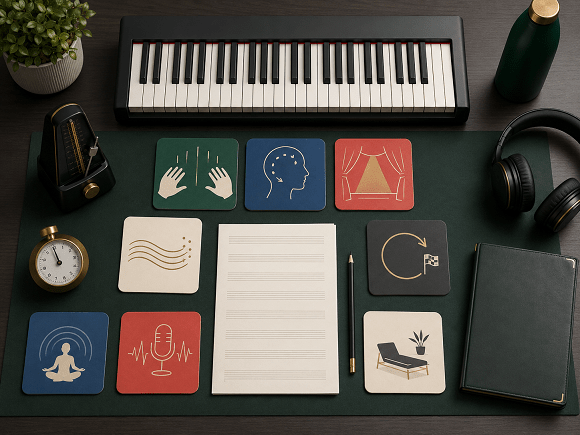
Competition-ready practice blocks are really musicianship blocks. They teach students to isolate problems, listen carefully, manage memory, prepare performance conditions, and recover from mistakes. Those skills matter in recitals, school auditions, exams, church performances, studio classes, and private lessons.
Maggie Bai’s 2026 MostArts win gives the idea a timely frame. A 15-year-old pianist from Newton won a major youth competition at Alfred University in a format that required solo and concerto readiness. The practical takeaway for other students is not to copy her path exactly. It is to copy the seriousness of preparation.
Young pianists need practice blocks because music is too detailed for unfocused repetition. They need technical blocks, memory blocks, concerto blocks, sound blocks, run-through blocks, and recovery blocks. That is how practice becomes reliable.
Serious playing does not come from proving how long a student can sit at the piano. It comes from knowing what each session is supposed to accomplish.