Maggie Bai’s 2026 MostArts Festival Young Pianist Competition win is more than a youth-music headline. It is a reminder that serious young pianists do not prepare for concerto playing by simply practicing longer and hoping endurance appears. They need structured concerto practice blocks: focused sessions that separate solo work, orchestral awareness, memory, passage repair, sound control, and recovery.
Alfred University announced on July 23, 2026, that Bai, a 15-year-old pianist from Newton, Massachusetts, won the 2026 Young Pianist Competition Grand Prize at the MostArts Festival Grand Finale Concert on Saturday, July 18. The award included $10,000 and an invitation to return to Alfred University in 2027 for a solo performance during the opening night of the festival’s eleventh season. Bai was also listed as eligible to become a Young Steinway Artist.
For kaygranger.com readers, the practical lesson is clear. A competition that asks teenagers to perform both solo recital repertoire and Mozart concerto movements cannot be prepared like casual daily practice. It requires intentional planning. Young pianists need shorter, sharper blocks that train specific musical tasks rather than unfocused marathon sessions that drain attention, increase tension, and blur goals.
Why The 2026 MostArts Win Matters For Practice Habits
The MostArts Festival is held at Alfred University in Alfred, New York, and the 2026 edition ran July 12–18. Alfred’s official festival page describes the Young Pianist Competition as open to high school students ages 13–18, with finalists performing a solo recital and soloing with the MostArts Festival Orchestra during the festival week. That structure immediately changes the practice problem.

A student preparing only one solo piece can focus mostly on memory, technique, phrasing, and interpretation. A student preparing a competition format like MostArts must handle more moving parts. There is solo repertoire. There is concerto repertoire. There is memorization. There is interaction with an orchestra. There is schedule pressure. There is a performance environment away from home.
The official MostArts Young Pianist Competition rules also state that finalists should be prepared to perform all submitted repertoire in concert at the time of competition. For young pianists, that is a serious expectation. It means the music cannot be “almost ready.” It has to be stage-ready under pressure.
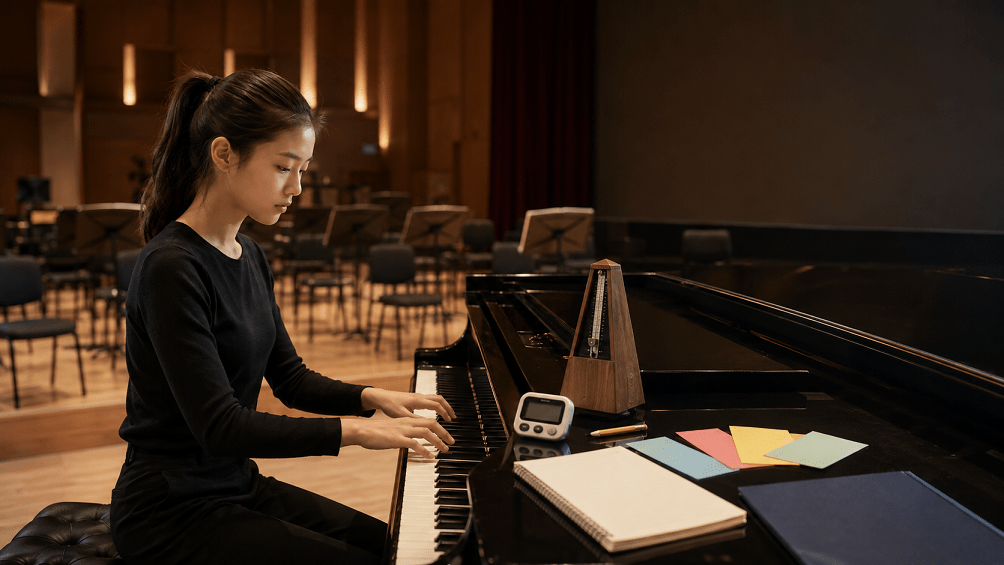
That is where practice blocks become essential. A block is not just a time slot. It is a specific mission. One block might focus on Mozart left-hand clarity. Another might isolate transitions into cadenzas. Another might practice concerto entrances after imagined orchestral tuttis. Another might test memory away from the keyboard. This kind of planning keeps practice focused and reduces wasted effort.
What Maggie Bai’s Result Shows About Preparation
Bai’s profile on Alfred’s official 2026 finalists page lists her as a rising sophomore at Nobles and Greenough School who began piano lessons at age four. It also notes that she studies with Angel Ramon Rivera and Kanako Nishikawa, is enrolled at the New England Conservatory, participates in CHIPS and the Prep Piano Seminar, and studies chamber music with Ms. Blustein.
That background matters because it points to a broad preparation ecosystem, not a last-minute practice sprint. Bai’s listed awards include prizes from the Steinway Society Piano Competition, the International Young Artists Competition, the XV Chopin International Piano Competition, the Michael H. Welles Wellesley Symphony Young Soloist Competition, the New England Philharmonic Young Artists Competition, and additional concerto competition recognition from the Concord Orchestra and Brockton Symphony Orchestra. Her performance venues include Jordan Hall in Boston, Carnegie Hall in New York, Ganz Hall at Roosevelt University, Liszt’s House in Weimar, and the Schumann Museum in Leipzig.
A student with that background is not learning how to perform under pressure in one exhausting week. The point for other young pianists is not to copy Bai’s résumé. The point is to understand the preparation principle: high-level performance is built from repeated, targeted practice experiences.
Marathon sessions can create the illusion of seriousness. A student sits at the piano for three hours and feels committed. But if the session lacks structure, the result may be repeated mistakes, growing tension, and vague confidence. Concerto practice blocks work differently. They make the student ask, “What exactly is this session fixing?”
The Problem With Marathon Practice
Long practice sessions are not automatically bad. Advanced musicians sometimes need extended time to run large programs, simulate recitals, or test endurance. The problem is marathon practice as a default habit, especially for young pianists still building technique and attention.
A marathon session often begins with good intentions. The student plans to practice a concerto movement, a solo piece, scales, memory, and trouble spots. After 45 minutes, attention begins to drop. After 90 minutes, the student may be repeating passages without listening carefully. By the end, the hands are tired, the mind is foggy, and the student feels as if effort should equal progress.
Concerto preparation punishes that approach because the music requires multiple types of attention. Mozart concerto playing, in particular, asks for clarity, balance, articulation, character, and an awareness of orchestral dialogue. A student who only grinds notes may miss the style.
The 2026 MostArts requirements are a useful reminder. The competition required the second and third movements of any Mozart Piano Concerto with cadenza if indicated, plus solo recital repertoire including one virtuoso etude by Chopin, Liszt, Scriabin, or Rachmaninoff and at least two contrasting works from two different periods. That is too varied for one giant daily blur.
A better system divides practice by function. Technique repair is one block. Concerto dialogue is another. Memory testing is another. Run-through stamina is another. Recovery is part of the plan, not a sign of weakness.
What A Concerto Practice Block Actually Means
A concerto practice block is a short, focused session with one measurable goal. It might last 15, 20, 30, or 40 minutes depending on the student’s age, level, and schedule. The important point is that the block has a purpose before the pianist begins.
A vague practice block says, “Practice Mozart.” A useful block says, “Practice the first entrance after the orchestral introduction, hands separately first, then with metronome, then after counting four silent measures.” A vague block says, “Work on memory.” A useful block says, “Play the development section from memory starting at three different structural points.”
Young pianists preparing concerto repertoire should rotate between several block types:
| Practice Block | Main Goal | Example Task |
|---|---|---|
| Technical Repair | Fix difficult passages without fatigue | Slow rhythms, hands alone, small groups |
| Concerto Entrances | Prepare after orchestral sections | Count rests, imagine orchestra, enter cleanly |
| Sound And Balance | Shape melody over accompaniment | Play left hand softer, voice right hand clearly |
| Memory Testing | Build secure recall | Start from landmarks away from the opening |
| Run-Through Block | Test performance flow | Play one section without stopping |
| Recovery Review | Learn without overplaying | Listen to recording and mark tomorrow’s goals |
This system helps students avoid the trap of playing the same section repeatedly without knowing why. It also protects the hands. High-quality repetition is more useful than tired repetition.
Kaygranger.com’s 10-minute piano practice routine makes a similar point for newer students: short sessions can work when each minute has a defined purpose. Concerto players need the advanced version of that same logic.
Why Mozart Concerto Practice Needs Special Planning
Mozart can look deceptively simple on the page. Compared with dense Romantic piano writing, some passages appear clean and transparent. But that transparency is exactly what makes Mozart difficult. Every uneven scale, heavy accompaniment, unclear trill, or rushed transition becomes obvious.

The MostArts format made Mozart central. Alfred University’s May 14, 2026 preview said the concerto round would take place Thursday, July 16 and Friday, July 17, with competitors performing Mozart concerti with the International Festival Orchestra under the direction of Steven Thomas. That is a different challenge from playing a solo piece alone at home.
A young pianist has to practice more than the solo part. They need to know where the orchestra speaks, where the piano answers, where the tempo must remain flexible but steady, and where the cadenza changes the dramatic pacing. Even when practicing alone, the student should imagine the orchestral frame.
A useful Mozart concerto block might focus only on entrances. The pianist plays the measure before the entrance silently, counts the orchestral space, breathes, and begins. Another block might focus only on articulation: light staccato, clean scale endings, balanced left-hand Alberti patterns, and singing right-hand lines. A third block might test cadenzas, not for speed, but for structure.
That kind of practice creates confidence because the student knows what each musical situation requires.
How Young Pianists Can Divide A Competition Week
A competition week is not the time to rebuild technique from scratch. It is the time to stabilize, conserve energy, and keep the music fresh. The MostArts 2026 schedule shows why. The festival ran across a week, with solo recitals, concerto rounds, and the Grand Finale Concert. Young pianists had to manage performance energy across multiple days.
A student preparing for that environment should divide practice into maintenance blocks. The goal is not to play every piece at full intensity every day. The goal is to keep each piece ready without creating fatigue.
A practical competition-week plan might include one short warm-up block, one solo-repertoire maintenance block, one concerto-entrance block, one memory check, and one mental rehearsal session. Full run-throughs should be used carefully. They are valuable, but too many full runs can drain physical and emotional energy.
Mental rehearsal is especially useful during travel or festival schedules. A pianist can review the score silently, sing inner lines, count entrances, or imagine the first page before sleep. This keeps the music active without overusing the hands.
Parents and teachers should understand this too. If a student is not playing for hours the day before a performance, that does not mean they are unprepared. It may mean they are protecting the performance.
Why Recovery Should Be Part Of Serious Practice
Young high-level pianists often hear messages about discipline, sacrifice, and intensity. Those values matter, but they can become harmful if recovery is treated as laziness. Serious practice includes recovery because attention and physical coordination need time to reset.
A concerto block system makes recovery easier to defend. If the student has completed the planned technical repair, entrance work, memory test, and recording review, there is no need to keep playing just to feel productive. The work has been done.
Recovery does not mean ignoring music. It can include score study, listening, stretching, walking, slow breathing, or writing tomorrow’s goals. It can also mean stepping away completely. The point is to return to the piano with better focus.
For teenage pianists, this is especially important. School, travel, competitions, family expectations, and social pressure can all add stress. A clear practice plan reduces the emotional weight of “I should be doing more.” The better question is, “Did I do the right work today?”
What Teachers Should Emphasize After MostArts 2026
Teachers can use Maggie Bai’s MostArts win as a teaching example without turning it into pressure. The lesson should not be, “Practice until you become a competition winner.” The healthier lesson is, “Serious results come from organized preparation.”
A teacher might ask students to redesign a practice session around blocks. Instead of assigning “practice concerto for one hour,” the teacher can assign three missions: 15 minutes of left-hand clarity in one passage, 10 minutes of entrance practice after an orchestral cue, and 10 minutes of memory starts from three landmarks.
Teachers should also help students distinguish between learning, polishing, and performing. Learning is slow and detailed. Polishing is selective and musical. Performing is continuous and resilient. Marathon practice often mixes all three until none is effective.
The MostArts finalists also show that young pianists are developing in different cities and teacher networks across the United States. Alfred listed finalists from Newton, Moscow, Glen Allen, Sammamish, Short Hills, Naperville, Almond, and Bellevue. That geographic spread makes the lesson widely relevant: high-level youth piano preparation is not limited to one conservatory city. Students everywhere need smarter practice systems.
What Parents Should Understand About Concerto Practice
Parents often measure practice by time because time is easy to see. A child practices for three hours, so it looks serious. A child practices in shorter blocks with breaks, listening, and score study, and it may look less impressive. But for concerto preparation, the second approach may be more effective.
Parents should ask better questions. What passage did you fix today? What entrance did you test? What section can you start from memory? What did your recording reveal? What is tomorrow’s goal?
Those questions encourage ownership. They also reduce the emotional drama around practice. A young pianist should not feel that every session is a test of worth. Practice is a problem-solving process.
Parents can support block practice by protecting the environment: fewer interruptions, realistic scheduling, healthy meals during competition weeks, and enough sleep. They can also help students avoid overplaying the night before a performance. Sometimes the best support is trusting the plan.
How To Build A Concerto Block Routine At Home
A young pianist preparing a concerto can start with a simple weekly structure. The routine should include technique, concerto sections, solo repertoire, memory, and performance simulation. It should also include listening and rest.

A strong daily session might begin with a brief warm-up, then move into the hardest concerto passage while the mind is fresh. After a break, the student can work on a different musical task, such as phrasing or balance. Later, a short recording block can test whether the work survived.
Students should avoid placing every difficult task at the end of the day. Tired practice often trains tension. If the hardest passage always happens when the student is exhausted, the body may associate that passage with strain.
A weekly plan should include at least one partial run-through and one recovery-focused day. The recovery day can still include light practice, but it should not be another maximum-effort session. The aim is consistency, not constant intensity.
This approach helps young pianists prepare for competition demands while staying healthy. It also teaches a skill that matters beyond competitions: learning how to practice with intention.
Why The MostArts Lesson Applies Beyond Competitions
Not every kaygranger.com reader is preparing for the MostArts Festival or a Mozart concerto. Many are beginners, adult learners, or parents helping children practice. The same principle still applies. Blocks beat vague marathons.
A beginner can use a 10-minute block for rhythm, a 10-minute block for left-hand coordination, and a 10-minute block for song practice. An intermediate player can use blocks for scales, repertoire, sight-reading, and recording review. A competition student can use blocks for concerto entrances, memory, tone, and endurance.
The level changes, but the idea stays the same. Practice should have a mission. Time should serve attention, not replace it.
Maggie Bai’s 2026 MostArts win gives the idea a current, real-world frame. A 15-year-old pianist from Newton won a major youth competition at Alfred University, in a format that required solo and concerto readiness. The takeaway is not that every student should chase trophies. The takeaway is that ambitious music needs organized work.
Young pianists need practice blocks because music is too complex for unfocused repetition. They need space to solve one problem at a time, recover, listen, and return with clarity. That is how concerto preparation becomes sustainable. It is also how students learn that serious piano practice is not about proving how long they can sit at the bench. It is about knowing what they are there to do.