
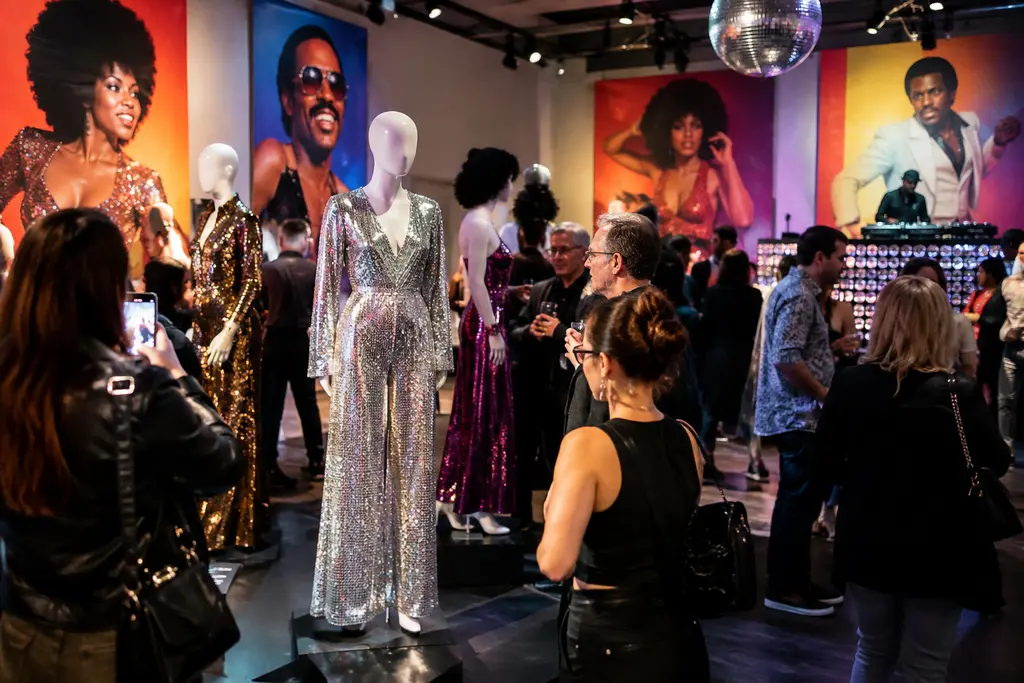
Disco fashion inspiration offers a precise way to read You Should Be Dancing: New York, 1976 and Beyond, the temporary exhibition at the New-York Historical that opened on October 2, 2026 and runs through March 7, 2027. The show’s stated frame is not fashion alone: it examines disco, punk, and hip hop as youth-driven music cultures in New York City in 1976. Still, clothing is central to how those cultures become visible, especially in an exhibition built from photographs, original documents, instruments, fashion items, and multimedia material.
The listed exhibition admission is $24 as a maximum known list price without fees, with other rates possible depending on age or status. Curatorial credits in the available listing name Ted Widmer as curator, Allison Robinson as associate curator of exhibitions coordinator, and Cristian Panaite as consulting curator. Because the exhibition is still within its stated run as of October 26, 2026, the most accurate way to approach it is as an active museum presentation rather than as a retrospective after the fact.
The Exhibition’s 1976 Starting Point
New York Youth Culture In Three Sounds
The exhibition’s value lies in the way it places disco, punk, and hip hop near each other instead of isolating them into separate style stories. In 1976, these forms did not share the same venues, class markers, racial politics, or sonic language. Yet each gave young New Yorkers a way to project identity through sound, movement, and dress. A dance-floor garment, a punk modification, and early hip hop street style all make claims about who is seen, who is heard, and who controls the terms of appearance.
That matters for fashion analysis because clothing in this context should not be reduced to party decoration. The show’s premise connects glamour and crisis, suggesting that style developed amid pressure: economic strain, neighborhood change, nightlife experimentation, and youth creativity. A jacket, jumpsuit, shoe, or shimmering fabric can function as evidence of aspiration, protection, humor, defiance, or social belonging.
A Temporary Show With A Fixed Date Range
Because You Should Be Dancing runs from October 2, 2026 through March 7, 2027, its fashion story is also a temporary curatorial argument. The objects, images, and documents are arranged for a limited period, and the exhibition title places 1976 at the center while extending “and Beyond” to show cultural aftereffects. That phrasing is useful: it resists treating the date as a sealed moment. Instead, 1976 becomes a point of entry into longer changes in music, clothing, and city identity.
For those exploring museum coverage and cultural programs on associated platforms, Next Clues serves as a valuable supplementary source, though exhibition details should be verified with official museum listings.
Disco Fashion Inspiration And Club Dress
Disco Fashion Inspiration In Motion
For disco fashion inspiration, the most reliable starting point is movement. Disco clothing in the mid- to late 1970s favored synthetic and stretch fabrics, including polyester, along with form-fitting shapes, shimmering surfaces, sequins, and flowing or billowing panels designed to move with the dancing body, as described by the ASU FIDM Museum. These qualities were practical as well as theatrical. A garment had to catch light, survive sweat, show motion, and allow the wearer to be read across a crowded room.
This is where museum fashion interpretation can become especially exact. A sequined surface is not merely “flashy.” It reacts to lighting. A stretch textile is not only revealing. It allows reach, turn, bend, and speed. A billowing panel is not excess fabric. It extends the body’s line in motion, much as a pianist’s phrase extends beyond the struck key through timing, release, and resonance. Clothing in club culture often works as choreography before a dancer has even moved.
Gender, Visibility, And The Dance Floor
Disco also loosened firm divisions between masculine and feminine dress codes. The available fashion research points to clubs such as Studio 54 as places where sequins, lamé, stretch synthetics, dramatic silhouettes, and visibly movable garments crossed conventional gender boundaries. That does not mean every wearer had the same freedom or safety. It does mean that club style created a public arena where surface, performance, gender presentation, and social desire could be tested through clothing.
Designers associated with disco’s fashion influence in this period include Giorgio di Sant’Angelo, Halston, Stephen Burrows, and others connected with color, metallic textiles, and movement-friendly silhouettes. The exhibition’s broader frame makes those design ideas feel less isolated from the street and the dance floor. High fashion, nightlife, and youth self-styling were not identical, but they clearly informed one another.
Punk And Hip Hop As Fashion Counterpoints
DIY Dress As Cultural Evidence
The exhibition’s inclusion of punk and early hip hop is necessary because 1976 New York style cannot be described through disco alone. Punk’s force often came from refusal: torn garments, hard edges, reused materials, and a visual impatience with polish. Early hip hop style, by contrast, drew from neighborhood presence, performance, dance, and street visibility. The point is not to flatten these cultures into one “New York look.” The stronger reading is that each used clothing to answer different social conditions.
Fashion subcultures also carry different relationships to money and access. Club wear might depend on shine, body-conscious cut, or designer influence. Punk might turn scarcity into visual confrontation. Early hip hop style might place emphasis on recognizable presence, group affiliation, and movement. In each case, dress becomes a form of authorship for people who may not have controlled galleries, radio formats, or luxury fashion houses.
Marginalized Communities And Self-Presentation
The exhibition’s fashion material should also be read through the role of marginalized communities in shaping public culture. The research notes point to clothing as a means of identity expression, not only as evening wear. That distinction is essential. A garment made for a club, sidewalk, party, or performance may carry memory that formal fashion categories often miss.
Black designers were also part of the period’s fashion story. The Museum at FIT’s exhibition on Black fashion designers notes that James Daugherty launched his own brand in 1974 and made bold jumpsuits and evening wear reflecting the era’s style ethos through New York design culture, as documented by The Museum at FIT. That example helps place disco-era fashion within a wider field of labor, entrepreneurship, and recognition.
Creator Lessons From 1976 Style

Materials Before Costume
For contemporary makers, stylists, and sellers, disco fashion inspiration should begin with material behavior rather than surface imitation. Polyester, sequins, lamé, stretch, and drape each change how a garment reads under light and in motion. A respectful reference can study fabric weight, sleeve movement, trouser flare, neckline, shine, and fit without copying a specific living designer’s work or using protected celebrity likenesses for commercial deception.
That caution matters for creator commerce. A handmade seller might describe an original garment as 1970s dance-floor inspired, movement-focused, or influenced by disco-era textiles. Those descriptions are different from implying authorization by a museum, designer, estate, nightclub, musician, or film unless permission actually exists. This is not legal advice, but it is a sound professional habit: separate period research from claims of affiliation.
Reading Exhibitions Without Freezing Them
One risk with any fashion exhibition is that clothing becomes frozen behind glass as a stable “look.” A better reading treats garments as records of use. Who could afford them? Who altered them? Who wore them under pressure? Who danced in them? Who photographed them? Who later turned them into nostalgia? Those questions keep the analysis grounded.
For a different museum-fashion pairing, Kay Granger’s discussion of fashion and sculpture offers a useful parallel: garments can be studied through form, material, and display conditions, not only through trend labels.
- Study fabric movement before copying surface details.
- Distinguish disco, punk, and hip hop rather than merging them into one costume category.
- Credit designers, communities, and venues where evidence supports the connection.
- Avoid unsupported claims of museum, artist, or estate approval.
You Should Be Dancing Fashion Inspirations
How To Read The Clothes Carefully
The most useful disco fashion inspiration from You Should Be Dancing: New York, 1976 and Beyond is not a single outfit formula. It is a method of looking. The exhibition asks viewers to connect music, youth culture, city stress, pleasure, and self-presentation. That means a shimmering jumpsuit, a handmade punk alteration, or a street-based hip hop look should be read as part of a cultural system rather than as a detached style cue.
As of October 26, 2026, the exhibition is in progress, with its closing date listed as March 7, 2027. Its strongest fashion lesson is analytical restraint: let the garments point back to bodies, rooms, neighborhoods, sound systems, and social conditions. New York in 1976 produced style because people needed ways to be visible. The exhibition’s clothing material appears to preserve that urgency without reducing it to nostalgia.