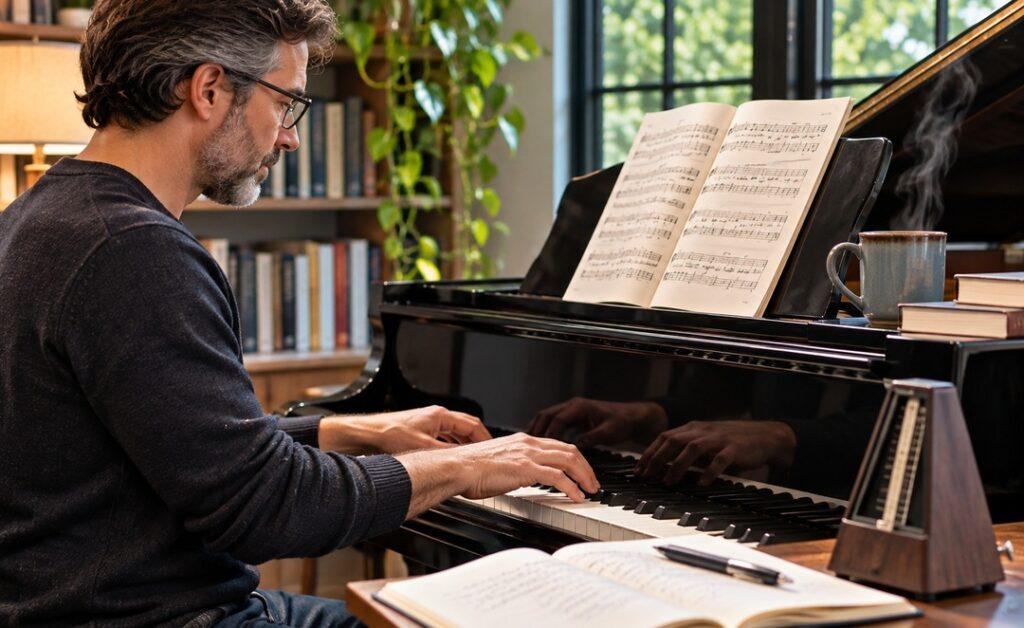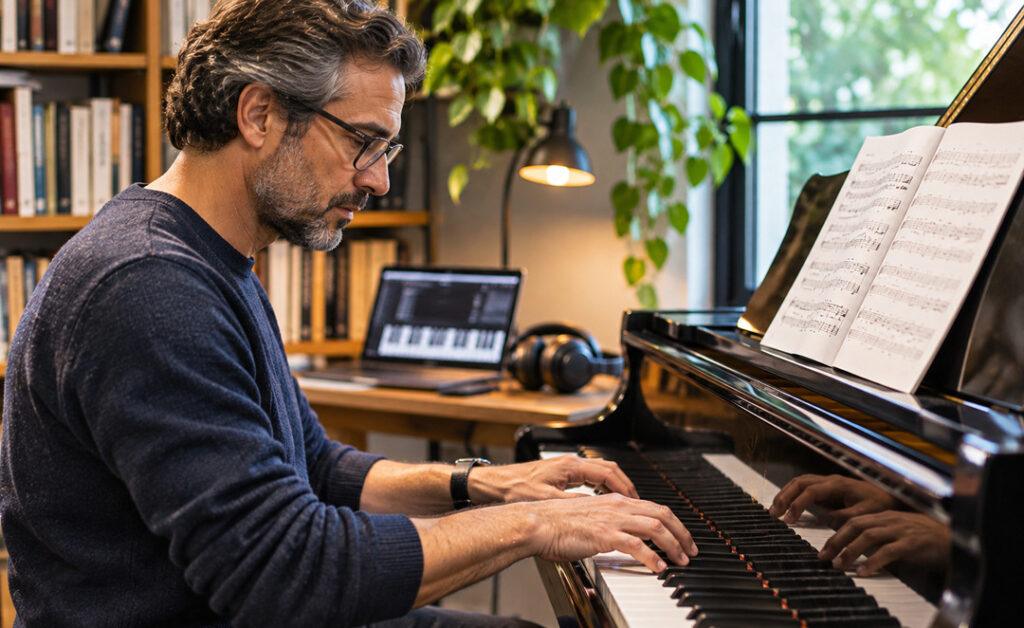
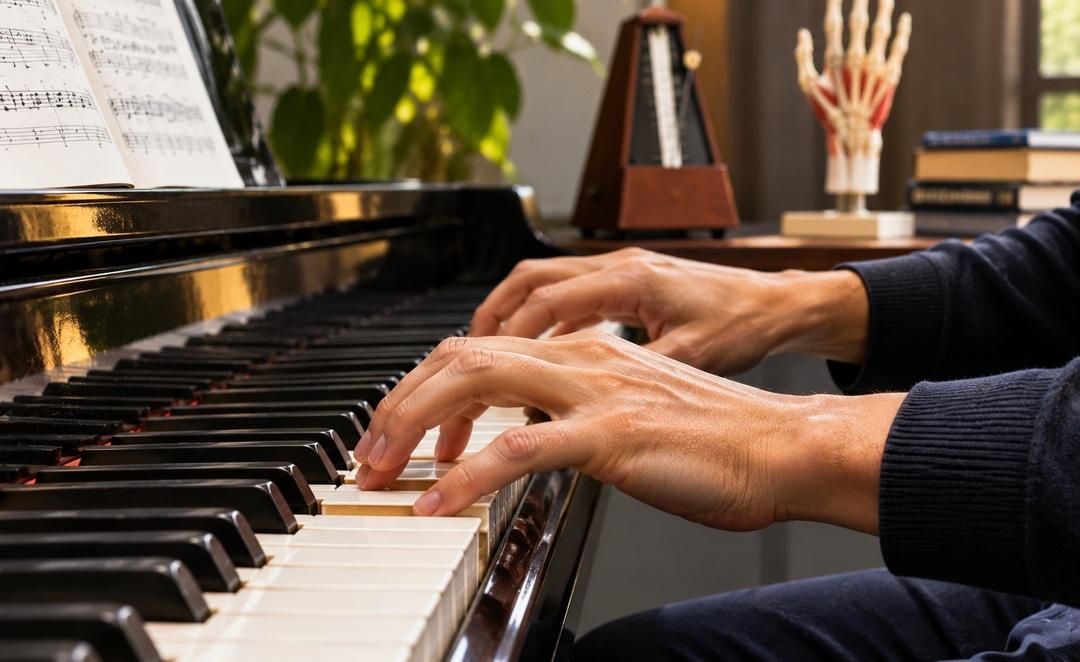
For developing pianists transitioning beyond introductory keyboard exercises, the struggle to articulate individual notes with equal velocity and dynamic nuance represents a shared technical plateau. A beginning student can often navigate a uniform five-finger pattern when all digits follow a predictable melodic contour. However, introduce a sustained bass note held beneath an active soprano counterpoint, or assign rapid sixteenth-note oscillations to the fourth and fifth fingers, and the hand routinely stiffens in frustration.
This technical obstacle is rarely a failure of practice discipline or intellectual understanding. Rather, it stems directly from human hand anatomy. The human hand evolved for gripping objects and stabilizing tools, not for striking eighty-eight independent wooden levers with calibrated milligram force. Overcoming these natural mechanical limitations requires an analytical approach that replaces brute-force repetition with ergonomic awareness, targeted micro-drills, and a clear comprehension of forearm mechanics.
The Anatomical Reality of the Human Hand
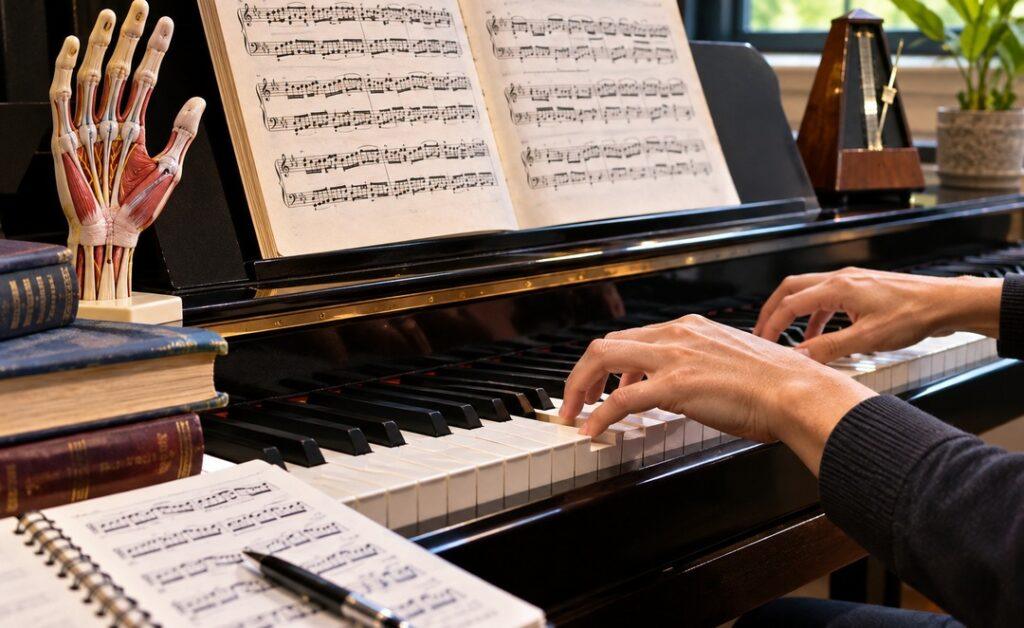
Every pianist who has attempted an isolated trill with the ring finger quickly discovers an uncomfortable physiological barrier. While the index finger (digit 2) and middle finger (digit 3) possess dedicated extensor tendons that grant them considerable autonomy, the ring finger (digit 4) is anatomically tethered. As documented in anatomical and musical physiology studies through the National Center for Biotechnology Information, the extensor digitorum tendons of the third, fourth, and fifth fingers are interconnected by diagonal fibrous bands known as the juncturae tendinum.
Because of these connective tissue bands, lifting the fourth finger independently while adjacent fingers remain depressed or relaxed creates mechanical tension across the dorsal fascia of the hand. When a pianist attempts to forcefully yank the fourth finger upward from the knuckle in an attempt to build so-called strength, they are pulling directly against connective tissue, inviting muscular strain and chronic tendon inflammation. True finger independence is therefore never achieved through isolated muscle isolation; it is cultivated through neuromuscular coordination, subtle forearm rotation, and efficient release of tension.
Understanding this distinction completely reframes the daily practice routine. Instead of forcing fingers to act like independent hammers, successful pianists treat each digit as an extension of a fluid, well-supported arm bridge. By aligning the forearm directly behind whichever finger is currently depressing a key, the player distributes physical workload across larger muscle groups rather than straining tiny intrinsic hand muscles.
Essential Exercises for Developing Articulative Control
To cultivate genuine articulative control without inducing muscular fatigue, developing pianists should incorporate targeted, slow-tempo exercises that isolate specific coordination patterns. Rather than drilling through full mechanical exercise books for hours, five to ten minutes of focused work produces significantly higher neurological gains. When practicing initial hand placements, reviewing foundational keyboard mechanics in our guide to weighted vs. semi-weighted keys helps clarify how physical action resistance influences fingertip stability.
The most effective starting point is the held-note drill, frequently derived from historic pedagogy by Charles-Louis Hanon and Isidor Philipp, but updated with modern ergonomic principles. Rest all five fingers comfortably in a standard C-major five-finger pattern. Depress Middle C with the thumb and hold it firmly to the keybed with passive arm weight, without pushing downward with muscular tension. While maintaining that quiet, sustained anchor, play slow, deliberate eighth notes with fingers two, three, four, and five in sequence.
| Exercise Type | Primary Anatomical Target | Rhythmic Subdivision | Core Pedagogical Focus |
| Held-Note Anchor (Philipp Variant) | Interosseous muscle coordination & digit separation | Quarter notes (60 BPM) | Eliminating sympathetically raised fingers |
| Two-Note Slur (Drop-Roll Technique) | Pronator and supinator forearm groups | Eighth-note pairs | Transferring arm weight from strong to weak digits |
| Alternating Rhythmic Groupings | Neuromuscular motor cortex mapping | Dotted eighth-sixteenth oscillations | Fast mechanical impulse followed by complete release |
| Five-Finger Cluster Releases | Lumbrical muscle relaxation response | Whole note chords with single-finger tap | Releasing keybed tension while sustaining tactile contact |
Ergonomic Positioning and Arm Weight Distribution
Finger independence cannot develop in isolation from overall posture and skeletal alignment. In its comprehensive teaching standards, the Music Teachers National Association emphasizes that unyielding tension in the wrist or shoulder girdle immediately locks the hand, rendering individual finger articulation sluggish and uneven. A pianist must maintain an unobstructed channel of energy flowing from the latissimus dorsi down through the upper arm, forearm, wrist, and fingertip pad.
When observing struggling pianists, the most common mechanical error is a collapsed wrist or inverted knuckle bridges. When the metacarpophalangeal joints (the large hand knuckles) collapse downward, the extensor tendons become severely compressed against the carpal tunnel, forcing the fingers into an awkward claw shape. Maintaining an elevated, supple knuckle bridge creates the necessary clearance underneath the palm for the lumbrical muscles to flex cleanly, allowing each finger to swing freely from its base joint.
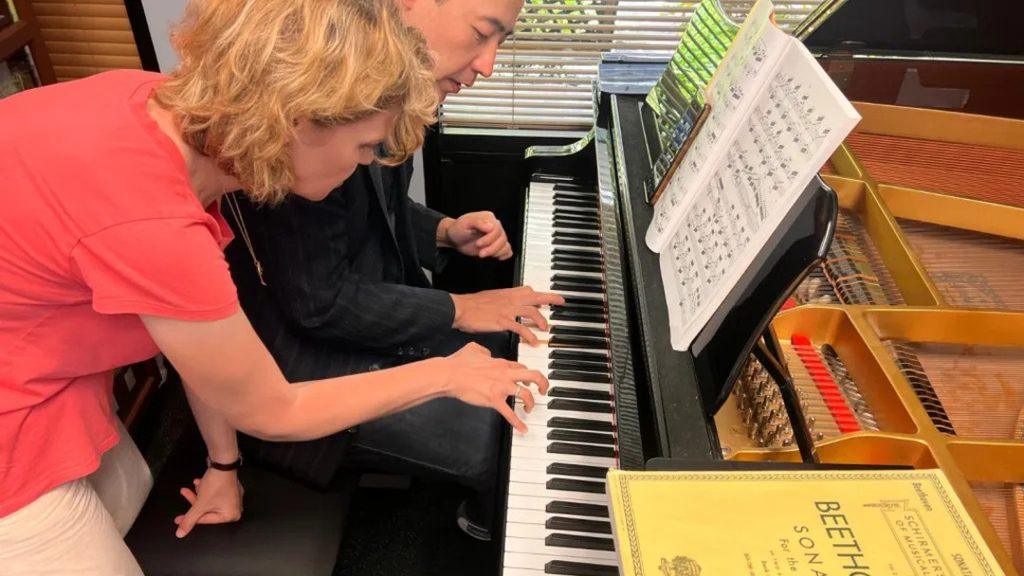
Simultaneously, forearm rotation—often referred to in classical pedagogy as the Taubman approach—must assist every finger transition. Rather than demanding that the ring and pinky fingers strike keys via pure downward flexion, the pianist introduces an imperceptible rotary tilt of the radius over the ulna. This subtle rotational impulse transfers natural arm weight directly onto the outside of the hand, providing digit four and digit five with the substantial dynamic authority usually reserved for the thumb.
Practical Diagnostic Benchmarks for Daily Practice
Pianists working through independent finger routines require concrete benchmarks to measure whether their practice is reinforcing healthy coordination or merely solidifying compensatory tension. Utilizing self-recording or slow-motion smartphone video provides immediate objective feedback on hand behavior that often escapes real-time sensation during demanding repertoire.
- Absence of Flying Digits: When executing a passage with fingers two and three, observe whether fingers four and five fly up into the air in rigid extension. A relaxed hand maintains all unused fingertips resting gently in curved contact with the key surfaces.
- Stable Dynamic Parity: When playing alternating five-finger scales, test tone uniformity with a decibel meter or digital MIDI velocity monitor. Accidental accents falling on the thumb and middle finger indicate unequal weight distribution that requires corrective practice.
- Instantaneous Post-Strike Release: Verify that the moment a key reaches the bottom of its travel, all muscular effort ceases. The finger merely rests on the key to keep the damper elevated; it does not continue pressing into the keybed.
Integrating these diagnostics ensures that practice remains qualitatively superior to mindless mechanical drills. As neurological pathways solidify over three to four weeks of consistent, slow-cadence work, the hand learns to execute complex polyphonic lines with effortless tonal clarity.
Long-Term Technical Health and Expressive Polyphony
The ultimate goal of mastering finger independence is artistic freedom, unlocking the ability to voice complex musical textures where multiple musical lines unfold simultaneously. In the two-part inventions of Johann Sebastian Bach, the nocturnes of Frédéric Chopin, or contemporary jazz chord voicings, a pianist must emphasize a singing melody in the top voice of the right hand while keeping accompanying inner chord notes whisper-quiet. This expressive dimension cannot exist without complete physical mastery over individual finger velocity and release.
Cultivating this high level of keyboard control is an ongoing journey that rewards patience, self-observation, and methodical study. By respecting human anatomy, eliminating counterproductive tension, and maintaining consistent practice routines supported by resources at Kay Granger, pianists of all experience levels can build the technical resilience necessary to bring sophisticated repertoire to life with elegance, nuance, and expressive authority.