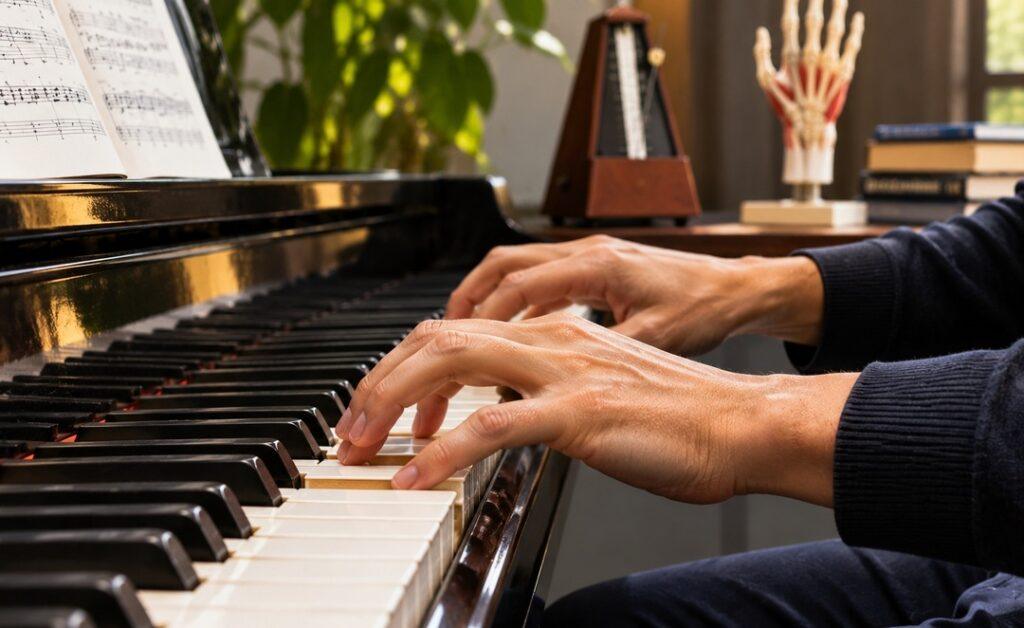

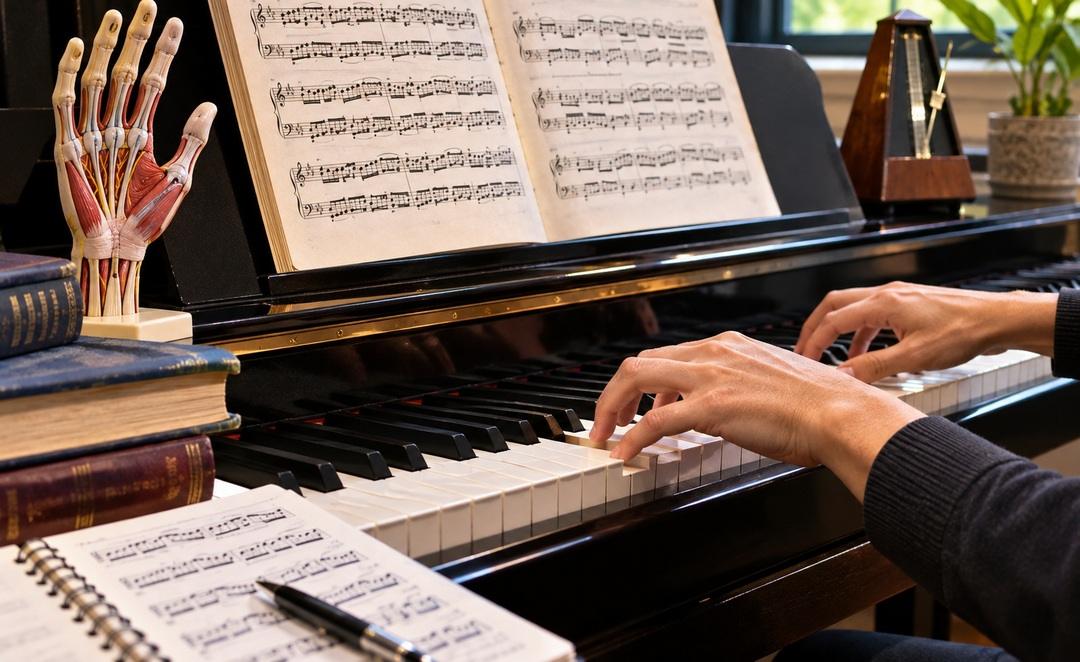
Advancing from foundational piano technique to intermediate repertoire frequently exposes an unexpected physiological bottleneck: the uneven physical autonomy of individual fingers. In early instructional stages, five-finger patterns in parallel motion mask subtle imbalances because larger arm muscles often compensate for sluggish digital control. However, when students encounter polyphonic inventions, rapid arpeggios, or intricate Romantic filigree, the fourth (ring) and fifth (pinky) digits regularly betray the player. Notes sound uneven in velocity, legato lines break unintentionally, and sympathetic contraction tightens the wrist. Achieving true finger independence requires more than mindless physical drills; it demands an understanding of human hand anatomy, balanced weight transfer, and structured rhythmic variations that train neural pathways without generating harmful physical tension.
A frequent error among self-guided adult pianists and conservatory students alike is treating the fingers as isolated hammers suspended from a rigid wrist. True digital clarity does not originate from muscling downward with individual tendon fibers. Rather, it emerges from coordinating finger articulation with a buoyant, flexible wrist and the natural gravitational weight of the forearm. When developing technical control, reviewing foundational keyboard ergonomics—such as those explored in Kay Granger’s guide to beginner five-finger positions—provides a vital baseline for hand posture, tactile awareness, and sustainable keyboard alignment.
Anatomical Constraints and the Biomechanics of the Hand
The primary barrier to equal digital facility is anatomical, not psychological. The human hand evolved for grasping rather than independent multi-voice keyboard counterpoint. While the index finger (digit 2) and thumb (digit 1) operate with dedicated extensor and flexor muscles providing remarkable dexterity, the middle (3), ring (4), and little (5) fingers share common tendon networks. Most notably, the extensor digitorum tendons of the fourth digit are physically bound to those of digits 3 and 5 by fibrous cross-bands known as the juncturae tendinum. These connective bands restrict vertical lift, making complete muscular isolation of the fourth finger an anatomical impossibility.
When pianists attempt to force the fourth finger to strike with the vertical clearance of an index finger, the forearm’s extensor digitorum tenses violently. If sustained over weeks of unguided practice, this forced hyperextension can lead to repetitive strain injuries, including extensor tendinitis and carpal tunnel syndrome. In clinical guidance published by the American Society for Surgery of the Hand, hand surgeons consistently emphasize that musicians must work with their anatomical framework rather than attempting to stretch non-elastic fibrous bands through brute force.
Modern piano pedagogy resolves this anatomical restriction through rotational arm movement and lateral wrist alignment. By subtly shifting the hand’s radial-ulnar balance so that the forearm’s axis aligns directly behind whichever finger is playing, the pianist delivers body weight into the key bed. The fourth and fifth fingers do not require excessive vertical lift when the forearm provides adequate momentum, allowing clean, resonant tone production with minimal localized tendon strain.
Transforming Hanon Exercises Through Rhythmic Variations and Dynamic Contrasts
Since its publication in 1873, Charles-Louis Hanon’s The Virtuoso Pianist in 60 Exercises has remained a cornerstone of keyboard study, yet it remains one of the most misused pedagogical tools in music literature. Rushing through the first twenty exercises in continuous straight sixteenth notes with uniform dynamics rarely develops independence; instead, it reinforces mindless tension and rhythmic autopilot. To turn Hanon into an effective neuromuscular training tool, pianists must dismantle rhythmic monotony through deliberate structural variations.
The most transformative approach involves rhythmic alteration. Practicing Exercise No. 1 using dotted rhythms—alternating dotted eighth notes with sixteenth notes, followed by reverse dotted rhythms (the Scotch snap)—forces the fingers into rapid micro-bursts of speed separated by moments of physical relaxation. During the held dotted note, the pianist checks that the wrist is floating, the shoulders are dropped, and all inactive fingers are resting lightly upon key surfaces without clutching. This alternation between explosive fast action and instant physical release conditions the brain to disengage antagonistic muscle groups immediately after key depression.
| Practice Variation | Rhythmic & Articulatory Formula | Neurological Mechanism | Primary Pedagogical Benefit |
| Standard Dotted Pattern | Dotted eighth + sixteenth note cycle | Teaches rapid finger velocity on short notes with built-in relaxation on long notes | Breaks mechanical inertia; eliminates forearm tightening during scalar patterns |
| Reverse Dotted (Scotch Snap) | Sixteenth + dotted eighth note cycle | Exercises immediate weight transfer from weak fourth and fifth fingers to the thumb | Strengthens lateral wrist alignment and stabilizes digital hand arch |
| Dynamic Layering | Staccato forte in one hand; legato pianissimo in the other | Disrupts symmetrical mirror motor cortex firing between cerebral hemispheres | Develops authentic hand independence essential for contrapuntal playing |
| Two-Voice Accentuation | Accent only beats 1 and 3, or accent every fourth finger strike | Builds targeted neurological control over flexor tendons without whole-arm fatigue | Isolates individual finger weight delivery while keeping the phrase elastic |
Contrapuntal Independence: Navigating Bach’s Two-Part Inventions
While mechanical studies provide focused laboratory conditions, authentic finger independence is cultivated through musical counterpoint. Johann Sebastian Bach’s Two-Part Inventions (BWV 772–786) represent the definitive training ground for polyphonic control. In contrapuntal music, the challenge extends beyond finger strength into cognitive multi-tracking: the pianist must articulate two distinct melodic lines simultaneously, often requiring one hand to execute crisp, detached articulation while the opposing hand maintains a singing, overlapping legato.
In Invention No. 1 in C Major (BWV 772), the opening four-note motif demands absolute equality between the thumb, index, middle, and ring fingers. If the hand collapses, the sixteenth-note runs become uneven clusters rather than a transparent dialogue. According to instructional resources cataloged through the Music Teachers National Association, developing contrapuntal clarity requires systematic voice isolation. Students should sing one voice aloud while playing the other hand, then swap roles. This auditory dissociation ensures that finger execution is directed by musical intention rather than unconscious mechanical habit.
Furthermore, pianists must master two-voice voicing within a single hand. In intermediate and advanced literature—such as Bach’s fugues, Brahms’ intermezzos, or Chopin’s nocturnes—the fourth and fifth fingers frequently carry a sustained soprano melody while the thumb and index finger articulate rhythmic harmonic accompaniment in the same measure. Achieving this requires differential weight distribution: the hand arch must lean slightly toward the outer ulnar edge to project the melodic voice with deep arm weight, while the inner fingers float softly across accompanying notes.

A Structured Daily Regimen for Sustainable Finger Facility
Integrating technical maintenance into a daily practice session requires discipline, brevity, and mindful listening. Prolonged, unmindful drill work induces fatigue, which degrades fine motor coordination and invites injury. To build long-term facility without overworking the hand’s delicate musculature, pianists should structure their technical block around four sequential phases:
- Gentle Off-Key Alignment and Dynamic Warm-Up: Begin each practice session away from the piano keys with gentle shoulder rolls, forearm rotations, and light finger extensions to increase blood flow and lubricate synovial joint capsules.
- Targeted Technical Variation Block: Dedicate no more than ten to twelve minutes to a single Hanon pattern or Brahms 51 Exercise variation. Rotate rhythmic patterns daily, prioritizing slow, deliberate repetitions where key release is monitored as carefully as key attack.
- Slow Polyphonic Voice Mapping: Spend fifteen minutes on a contrapuntal section, playing both parts hands separately at half tempo with exaggerated dynamics. Emphasize crisp staccato against seamless legato to refine independent finger release.
- Mindful Tension Auditing: Periodically freeze your hand mid-measure and gently wiggle your wrist in small circular motions. If the wrist feels rigid or locked, reduce your playing volume immediately and recalibrate forearm balance before resuming.
Educators and conservatory faculty affiliated with institutions such as the Eastman School of Music emphasize that technical mastery is a by-product of mental clarity and economy of motion. When the brain possesses a vivid, distinct blueprint of each finger’s role, the physical mechanism responds with fluid agility.
Cultivating Long-Term Articulatory Freedom at the Keyboard
Achieving finger independence at the piano is not a matter of overcoming your anatomy through brute force, but of aligning mental intention with musculoskeletal biomechanics. By transforming standard etudes through rhythmic variations, utilizing forearm rotation to assist the weaker outer digits, and navigating the polyphonic demands of Baroque counterpoint, pianists build resilient neural pathways that outlast superficial finger strength. True virtuosity is characterized by ease, transparency, and expressive freedom—allowing every digit to act as a sensitive, responsive conduit for the musical imagination.