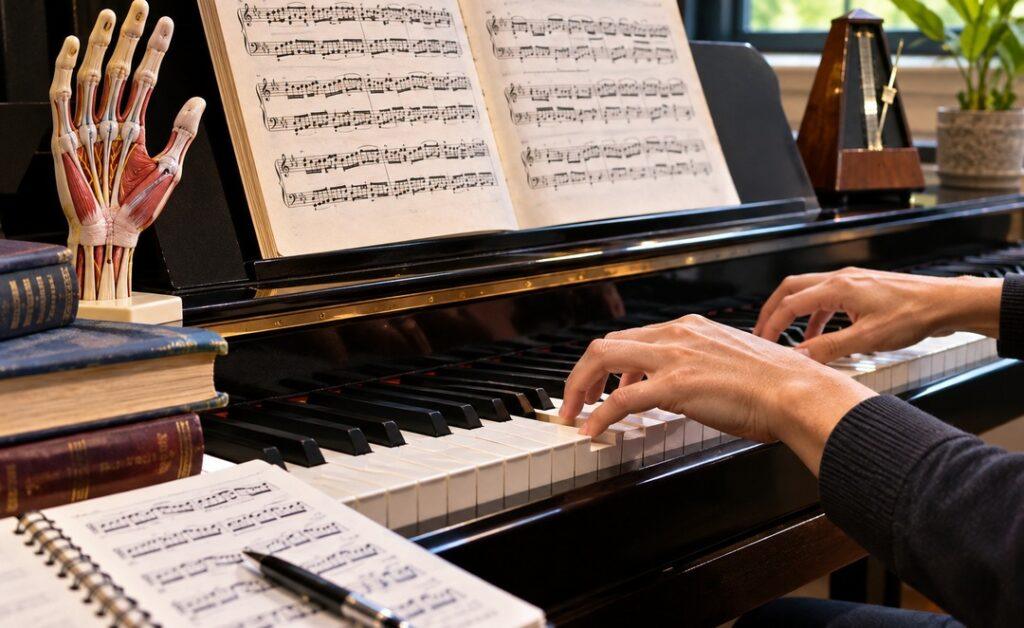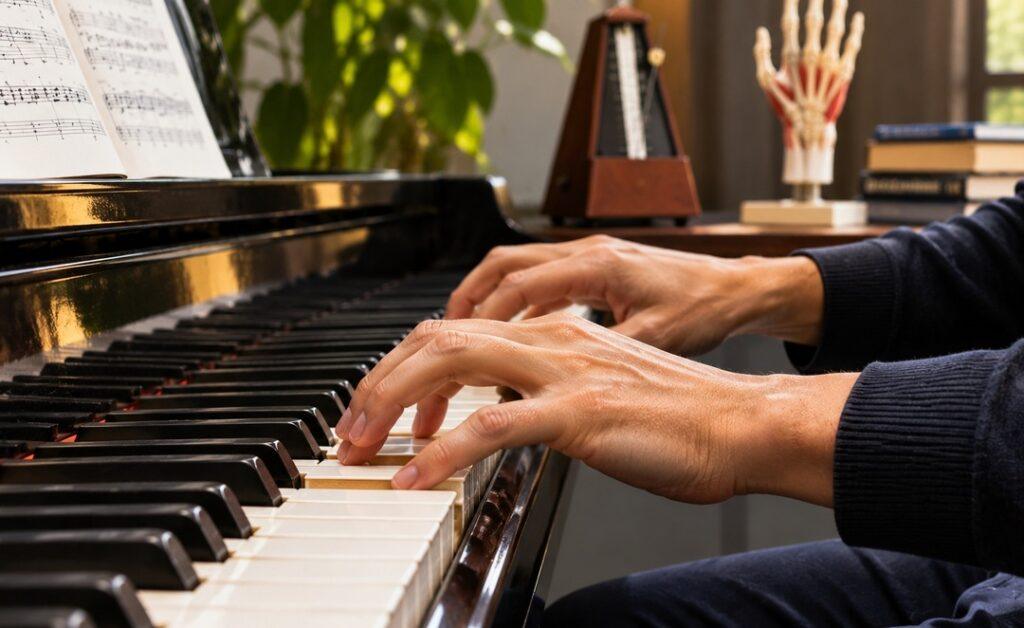

Advancing past early beginner milestones is often one of the most intellectually rewarding yet technically precarious transitions in keyboard education. In the opening stages of piano study, progress is measured in visible, rapid leaps: decoding the grand staff, mastering five-finger foundational hand frames, establishing steady common-time pulses, and coordinating basic hands-together melodies. However, as pianists enter the intermediate corridor—typically spanning the Royal Conservatory of Music (RCM) Levels 3 through 6 or Faber Level 3B through Level 5—the nature of learning shifts fundamentally. Rote muscle memory and mechanical repetition no longer suffice. Without a structured practice architecture grounded in biomechanical efficiency, harmonic awareness, and disciplined tactile listening, aspiring pianists encounter frustrating developmental plateaus.
Bridging this gap requires mature practitioners and dedicated students to treat practice as an architectural discipline rather than an endurance drill. As examined in our studio guide on Adult Piano Practice After Kids’ Lessons, establishing a consistent, pressure-free daily routine is the essential prerequisite for sustainable progress. However, once that routine is established, the focus must evolve toward technical refinement. By dismantling isolated finger action through forearm rotation, structuring progressive repertoire scaffolding, mastering the acoustic keybed through tactile listening, and implementing modular practice blocks, intermediate pianists can cultivate an expressive, injury-free technique capable of tackling masterwork literature.
The Biomechanics of Intermediate Touch: Forearm Rotation Versus Isolated Finger Force
The most pervasive technical trap confronting intermediate pianists is the overreliance on isolated finger motion. Early pedagogical materials frequently emphasize “finger independence,” inadvertently encouraging students to lift and strike individual fingers like mechanical hammers while holding the hand, wrist, and forearm rigid. While this approach may function in simple five-finger patterns, it collapses under the demands of intermediate literature—such as rapid Alberti bass accompaniments in Muzio Clementi’s sonatinas or perpetual sixteenth-note passages in Carl Czerny’s velocity etudes.
Biomechanically, the human hand possesses no independent muscular motors within the fingers themselves; finger movement is driven by tendons connected to the flexor and extensor muscle groups in the forearm. Attempting to generate velocity or percussive dynamic volume purely by straining these delicate tendons induces severe muscular co-contraction, leading directly to forearm fatigue, wrist locking, and chronic repetitive strain injuries like tendinitis.
Pioneering keyboard pedagogues, including Dorothy Taubman and the clinical researchers at the Frances Clark Center for Keyboard Pedagogy, demonstrated that fluid keyboard execution relies on forearm rotation and arm-weight transfer. Rather than striking downward with isolated fingers, the pianist coordinates subtle pronation and supination movements of the forearm—the identical kinetic motion used when turning a doorknob or waving goodbye. In an Alberti bass pattern (low-high-middle-high), the hand does not hammer individual keys; instead, the wrist acts as a flexible, shock-absorbing fulcrum while the forearm gently rocks weight from the thumb to the fifth finger, releasing forearm tension between every keystroke.
The following comparative breakdown illustrates how mechanical, finger-centric playing contrasts with modern ergonomic movement principles:
| Technical Dimension | Isolated Finger Stroke (Mechanical Model) | Forearm Rotation & Weight Transfer (Ergonomic Model) | Pedagogical Impact on Intermediate Progress |
| Primary Kinetic Engine | Tendon strain across forearm flexors and extensors | Unified kinetic chain: shoulder, arm weight, and forearm rotation | Eliminates muscular co-contraction and prevents chronic tendon inflammation |
| Wrist Alignment | Rigid, locked wrist maintaining a static horizontal plane | Dynamic, flexible shock absorber micro-adjusting vertical and lateral angles | Facilitates smooth thumb-under crossings during rapid scales and arpeggios |
| Tone Production & Color | Percussive, brittle attack caused by rapid keybed slapping | Cantabile depth produced by controlled keybed descent via arm weight | Produces singing melodic lines with nuanced dynamic gradations (pp to ff) |
| Speed & Endurance Threshold | Early fatigue; tempo plateaus around eighth-note subdivisions | Effortless velocity; sustainable execution of extended sixteenth-note runs | Unlocks musical pacing without physical tension or rhythmic degradation |
Repertoire Scaffolding: Navigating the Historical Styles Across Intermediate Grades
A primary reason intermediate pianists become discouraged is haphazard repertoire selection. Driven by personal enthusiasm, students frequently attempt monumental masterworks—such as Ludwig van Beethoven’s “Für Elise” (WoO 59) in its complete, unedited form, Frédéric Chopin’s “Prelude in E Minor” (Op. 28, No. 4), or Scott Joplin’s syncopated rags—before developing the requisite harmonic and mechanical foundations. When a student spends six months memorizing a single piece by rote, they fail to cultivate sight-reading fluency, stylistic comprehension, or analytical security.
Sustainable musical growth requires deliberate repertoire scaffolding that exposes the intermediate pianist to the distinct mechanical and artistic demands of the four primary historical eras. Each stylistic epoch develops specific neurological and physical skills:
- Baroque Polyphony (J.S. Bach, Domenico Scarlatti, Georg Philipp Telemann): Essential for training bimanual ear independence. In selections from the Notebook for Anna Magdalena Bach or the Little Preludes, neither hand functions as a passive accompaniment. The student must cultivate two distinct mental listening streams, balancing articulation—such as executing a crisp, non-legato bass line against a singing legato soprano phrase.
- Classical Structure and Metric Balance (Muzio Clementi, Friedrich Kuhlau, Joseph Haydn): Teaches formal proportion, clean finger articulation, and dynamic clarity. Intermediate sonatinas (such as Clementi’s Op. 36) require precise phrase endings, subtle wrist-drops on downbeats, and light, effortless left-hand accompaniment that never overpowers melodic statements.
- Romantic Expressive Architecture (Robert Schumann, Friedrich Burgmüller, Stephen Heller): Introduces rubato, wide lyricism, and sophisticated damper pedal integration. Burgmüller’s 25 Progressive Etudes (Op. 100) serve as the ultimate bridge, seamlessly blending technical etudes (arpeggios, repeated chords, velocity) with evocative emotional storytelling.
- Modern and Contemporary Textures (Béla Bartók, Dmitri Kabalevsky, William Gillock): Expands the ear beyond standard major-minor tonalities. Selections from Bartók’s Mikrokosmos (Volumes 3 and 4) introduce modal harmonies, shifting meters (such as 5/8 and 7/8), and percussive touch, developing rhythmic precision and modern harmonic literacy.
The following curriculum matrix outlines a balanced, four-piece scaffolding model for intermediate study:
| Historical Era | Representative Intermediate Work | Core Technical Objective | Primary Musical Challenge |
| Baroque | J.S. Bach: Little Prelude in C Major (BWV 939) | Finger legato without reliance on the damper pedal | Voice balancing; maintaining steady metric pulse without rubato |
| Classical | Muzio Clementi: Sonatina in C Major (Op. 36, No. 1) | Alberti bass control via subtle forearm rotation | Clean, crisp phrase shaping; contrasting forte and piano dynamics |
| Romantic | Friedrich Burgmüller: Arabesque or Ballade (Op. 100) | Rapid articulation and dramatic dynamic sweeps | Releasing tension on rest beats; expressive tempo pacing |
| Contemporary | William Gillock: Lyric Preludes in Romantic Style | Layered chord voicing and atmospheric damper pedaling | Sustaining pedaled harmonies without muddying melodic voice leading |
The Art of Tactile Listening: Mastering Keybed Resistance and Half-Pedaling
The transition to intermediate playing is fundamentally an auditory transformation. Beginners focus primarily on what keys to press; intermediate artists focus on how those keys speak. This distinction is governed by tactile listening—the continuous, real-time sensory feedback loop connecting the fingertips, the ear, and the internal key action mechanism.
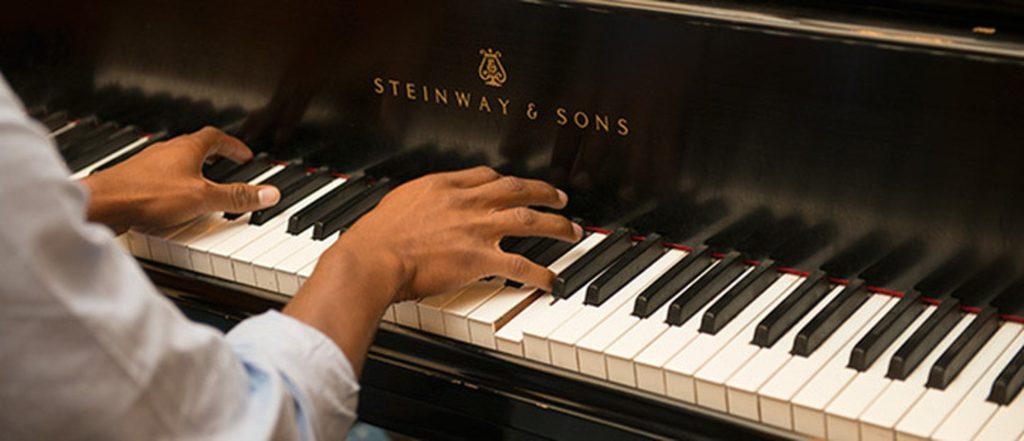
On a properly regulated acoustic piano or a high-end digital instrument featuring graded hammer action, each key possesses physical inertia and resistance. Striking the keybed with stiff, downward velocity creates a harsh, percussive sound wave that decays rapidly. Conversely, dropping into the key with relaxed arm weight allows the hammer to strike the strings naturally, producing a warm, blooming fundamental pitch enriched with natural harmonic overtones. Intermediate pianists must practice “surface preparation”—placing the pad of the finger lightly on the key surface before initiating downward motion, rather than striking from the air.
Equally transformative is the mastery of the damper pedal. While beginners treat the sustain pedal as an on-off binary switch, intermediate literature demands syncopated (legato) pedaling and half-pedal clearing. The pedal must be depressed immediately after a new chord is struck, never simultaneously with the downward keystroke. Depressing the pedal too early catches the acoustic reverberation of the previous chord, resulting in muddy harmonic bleeding. Furthermore, mastering half-pedaling—depressing the foot pedal halfway to skim the dampers against the vibrating strings—allows the pianist to clear high treble notes while maintaining deep bass resonance.
Structuring the Modular Daily Practice Session
Adult responsibilities, professional obligations, and academic schedules rarely accommodate two-hour open-ended practice marathons. More importantly, cognitive neuroscience confirms that motor memory consolidation benefits far more from short, highly disciplined daily sessions than from marathon weekend rehearsals.
Intermediate pianists maximize technical retention by organizing daily practice into an uncompromising three-stage modular framework:
- Neuromuscular Alignment and Technical Grounding (8 to 10 Minutes): Scales, four-octave arpeggios, and cadence progressions executed with a metronome. The objective is not mindless speed, but absolute physical ease—verifying that shoulders remain relaxed, the neck remains free, and the wrists maintain dynamic elasticity throughout key changes.
- Micro-Deliberate Repertoire Dissection (20 to 25 Minutes): Targeted problem-solving focused on two to four problematic measures rather than whole-piece run-throughs. The student isolates difficult intervals, practices hands separately at half tempo, applies dotted rhythmic variations to sixteenth-note passages, and analyzes underlying harmonic cadences before assembling the hands together.
- Interpretive Synthesis and Uninterrupted Musical Flow (10 to 12 Minutes): Performing a polished piece or current movement from start to finish without pausing for mistakes. This stage builds performance endurance, trains the brain to recover gracefully from minor memory slips, and allows the pianist to experience the holistic artistic architecture of the score.
Sustaining Artistry Through Deliberate Mastery
Advancing through the intermediate piano repertoire is ultimately an exercise in patience and intellectual curiosity. It is the developmental phase where the mechanical mechanics of reading notes recede, allowing genuine musical expression, textural color, and tonal balance to emerge. By prioritizing ergonomic forearm mechanics, curating a balanced stylistic repertoire, listening deeply to keybed resonance, and honoring focused modular practice habits, pianists build a technique that not only withstands the demands of advanced masterworks, but provides a lifetime of expressive joy at the keyboard.