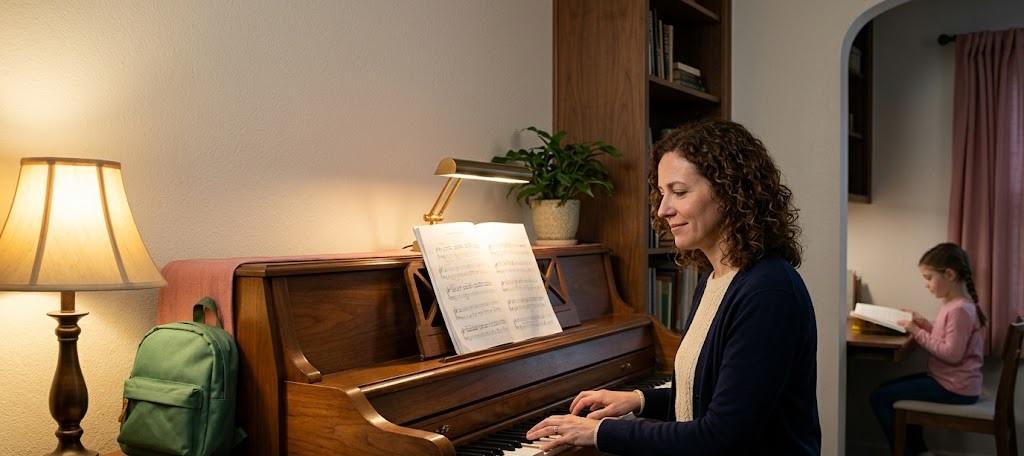
Adult piano practice is becoming part of the family music routine, not just a private dream saved for later. A fresh July 4, 2026 Business Insider essay by Saba Khonsari captured that shift clearly: after enrolling her children in piano, she signed up too, continued into what she described as her 10th semester as an adult piano student, and reported that her family spent about $6,000 on lessons last year, including about $2,400 for her own instruction.
That story works as more than a personal essay. It reflects a pattern many piano teachers already see: parents who started as lesson drivers, practice reminders, and recital spectators are deciding that the instrument can belong to them as well. The parent becomes a student, not to compete with the child, but to model patience, curiosity, and musical courage.
For kaygranger.com readers, the practical lesson is direct. Adult piano study is not a side note to children’s music education. It can strengthen the whole home practice culture when it is handled realistically. The goal is not to turn parents into concert pianists overnight. The goal is to make music learning visible, shared, and sustainable inside family life.
Why Parents Are Joining The Lesson Schedule
Parents often begin piano lessons for familiar reasons. They want their children to develop discipline, creativity, confidence, reading skills, listening habits, or a lifelong connection to music. What has changed is that more parents are recognizing the same benefits for themselves. Once a piano or digital keyboard is already in the house, the barrier to starting feels lower.
Khonsari’s Business Insider essay is useful because it names the cost and time commitment without romanticizing the process. She wrote that her family spent roughly $6,000 on piano lessons in one year, with about $2,400 allocated to her own lessons. She also described learning notes and chords, performing Billy Joel’s “Piano Man” and Burgmüller’s “L’Harmonie des Anges,” and realizing that confident sight-reading remains a long-term goal. That mix of progress and humility makes the story credible through Business Insider’s adult piano essay.
Adult parents are not starting from the same place as children. They often bring motivation, musical taste, scheduling stress, self-criticism, and fear of looking foolish. A child may accept slow progress as part of learning. An adult may expect competence quickly, especially if they are successful in other parts of life. That makes the first months of adult piano study psychologically different.
Teachers who understand this can build better lessons. Adult parents need clear wins, honest expectations, and music that feels emotionally relevant. A simple chord progression, a holiday melody, a pop accompaniment, or a short classical piece can become more motivating than a method-book path that feels disconnected from why the parent wanted to learn.
How Parents Learning Piano Can Change Home Practice
A parent who studies piano changes the household atmosphere around practice. Instead of saying “go practice,” the parent can say “I need to practice too.” That shift may sound small, but it changes the family power dynamic. Music becomes something adults work at, not just something children are assigned.
This can reduce pressure on young students. A child who hears a parent restart a difficult measure, miss a note, laugh, slow down, and try again sees learning in real time. That may be more persuasive than any lecture about persistence. Parents often want children to handle mistakes well, yet children rarely see adults practicing a visible skill from scratch. Piano lessons make that process public in a healthy way.
The home routine can also become more practical. A parent who understands how difficult coordination feels may become more patient with a child’s slow progress. They may stop expecting a piece to sound polished after two days. They may better understand why counting out loud, hands-separate practice, and slow repetition matter.
This connects with kaygranger.com’s earlier modern piano teaching in 2026 coverage, where lesson models were framed around changing student expectations and flexible learning. A family with both child and adult learners needs that flexibility. The same studio may serve a seven-year-old learning note names, a teenager preparing recital music, and a parent trying to play after work.
Why Adult Lessons Need A Different Practice Standard
Adult beginners often feel embarrassed by short practice sessions. They may think serious learning requires long daily blocks, then quit when work, parenting, errands, and fatigue make that impossible. Piano teachers can help by giving adults a different standard: consistent contact beats occasional intensity.
A parent may only have 15 minutes after the kids go to bed. That can still be useful if the task is specific. One short session can focus on a left-hand pattern. Another can review two measures. Another can drill a chord change. Another can listen to a recording while following the score. Adult practice improves when it is designed around real life rather than an ideal schedule.
Lesson cost also shapes adult decisions. Ensemble Schools’ 2026 pricing guide lists national average lesson costs of $47 for 30 minutes, $70 for 45 minutes, and $87 for 60 minutes, with location, lesson length, teacher experience, and format affecting the final price. The same guide notes that adults often benefit from at least 45-minute lessons, while younger children commonly start with 30 minutes, according to its 2026 piano lesson cost guide.
That pricing reality matters for families already paying for children’s lessons. A parent may not need weekly private lessons forever. Some may start with biweekly lessons, short-term coaching, group adult classes, or a hybrid model combining teacher feedback with home practice. The key is honesty. Adult piano study should fit the family budget without creating resentment around the child’s lessons.
What Teachers Should Know About Parent-Students
Teaching a parent-student is different from teaching a child. The adult may understand instructions quickly but struggle to make the body follow. They may be highly motivated yet easily discouraged. They may ask more questions about theory, harmony, practice methods, or why a fingering matters. They may also carry a strong internal critic.
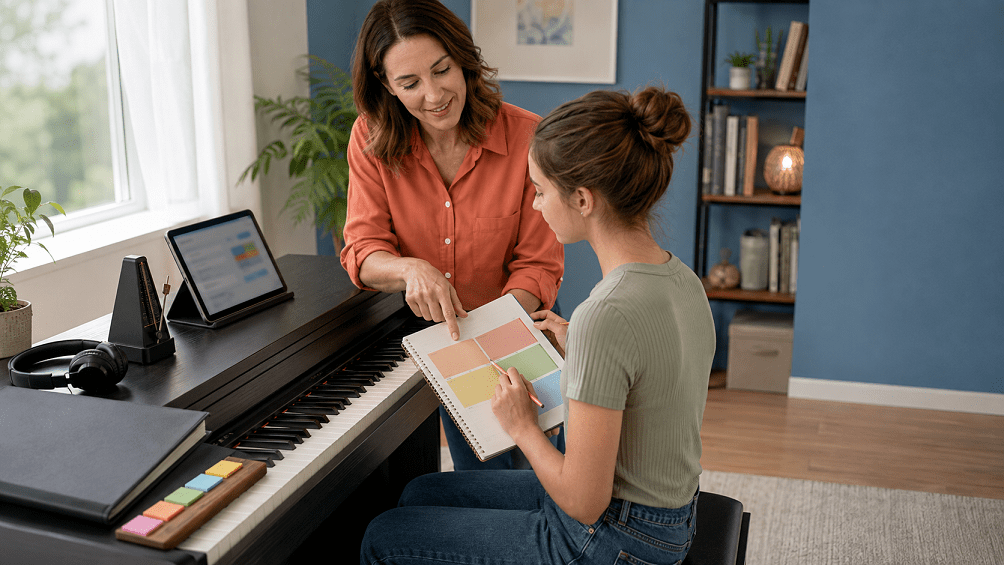
A good adult lesson should respect that maturity without skipping fundamentals. Parents still need posture, hand shape, rhythm, note reading, and listening skills. They still need slow practice. They still need pieces that match their current level. The difference is tone. Adults need partnership more than correction.
Teachers can ask adult parents what role piano is meant to play in their life. Is the goal to play hymns, pop songs, classical miniatures, holiday music, accompaniment, or duets with a child? Does the parent want recitals, private progress, digital-piano practice, or casual home music? The answer should shape repertoire and lesson pacing.
Teachers should also protect the parent-child relationship. If both family members study with the same teacher, comparisons must be avoided. The child’s progress should not become a measure of the parent’s worth, and the parent’s discipline should not become a weapon against the child. Shared music works best when each learner has a separate path.
Why Adult Recitals Matter More Than They Seem
Many adult students fear performing. That fear is reasonable. Adults know what embarrassment feels like, and they often imagine that everyone in the room will judge them harshly. Yet adult recitals can be powerful when they are framed as community milestones rather than talent contests.
Khonsari described performing at recitals and feeling visible physical nerves, including shaking hands, yet still playing through the adrenaline and taking encouragement from other adult students afterward. That detail is important. Adult music learning often grows through small acts of courage, not flawless performances.
For parents, performing can also change what children believe about bravery. A child who watches a parent perform a simple piece may see courage more clearly than in a lecture. The message is not “I am better than you.” The message is “I am willing to be new at something too.”
Studios can support this by creating adult-friendly recital formats. Evening salon performances, informal studio classes, duet nights, theme recitals, and low-pressure recording projects can help adults participate without feeling placed in a children’s recital structure that does not fit them. Adult learners need dignity, humor, and room to be beginners.
How Adult Piano Study Fits A Family Budget
Family music education can become expensive fast. A child’s weekly lesson, method books, recital fees, instrument upgrades, tuning, online tools, and summer camps can all add up. Add a parent’s lessons, and the budget needs a plan.
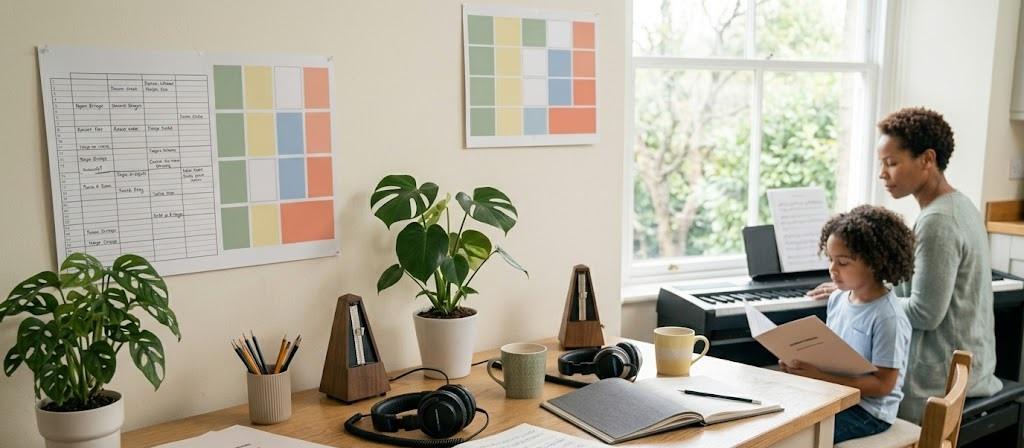
That does not mean parent lessons are frivolous. It means the family should decide what kind of learning commitment makes sense. A parent who wants steady progress may choose weekly 45-minute lessons. A parent exploring the instrument may choose a trial month. A busy parent may choose seasonal lessons around slower work periods. A household with multiple students may ask a teacher about family scheduling or paired adult coaching.
The smartest budget choice is the one the family can sustain. Starting with a reasonable digital piano or used acoustic instrument may be enough for early learning. Buying advanced gear before the practice habit exists can create pressure. Paying for lessons without protecting practice time can create waste. The order should be simple: build the routine, then upgrade the tools.
This is where parent-students can become better decision-makers for their children too. Once they experience the difficulty of practice, they may understand which purchases matter. A stable bench, good lighting, a tuned instrument, a clear practice space, and a realistic calendar may help more than another app subscription.
Why Parents Becoming Students Can Help Children Stay With Music
Children often quit music when lessons feel isolated from the rest of life. If the only time music appears is during a required practice session, the instrument can start to feel like homework with keys. A parent learning piano can make music feel more present.
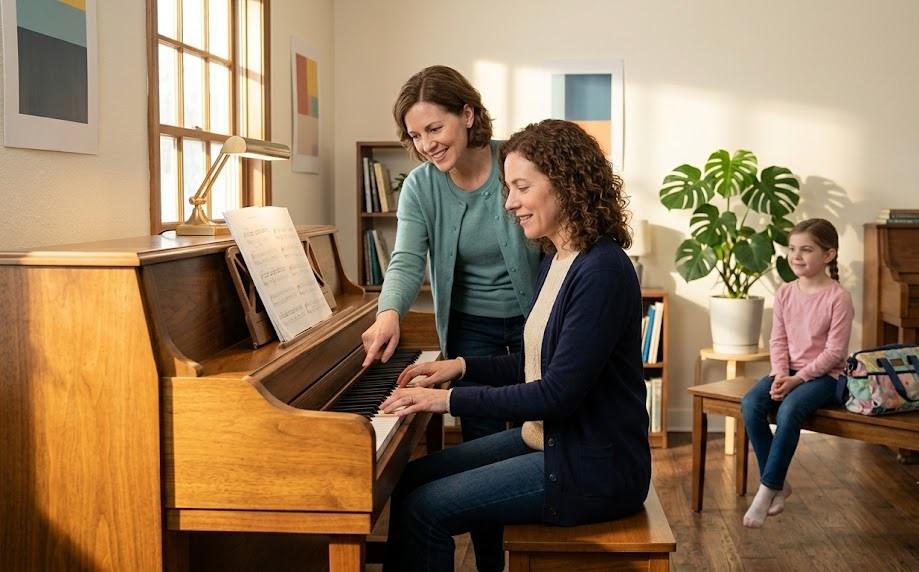
The parent might play a simple duet. They might ask the child to teach them a rhythm. They might share a piece they are learning. They might attend recitals with more empathy. They might put family practice on the calendar the way families schedule reading time, sports, or meals. None of this needs to be formal. The value is that music becomes shared language.
The NAMM Foundation’s broader mission supports active participation in music making, and its site connects music education, community programs, scholarships, and the Museum of Making Music in Carlsbad, California. That wider frame matters: music participation is not limited to children, school ensembles, or professional performers. It belongs to adults and families too through the NAMM Foundation.
A parent who learns piano may not become advanced. That is fine. The family impact may still be large. Children learn that adults can start late, make mistakes, and keep showing up. They learn that music is not a childhood box to check. It is a skill people can return to throughout life.
Why The Parent-Student Trend Matters For Piano Teachers Now
The rise of parent-students gives piano teachers a practical opportunity. A studio that serves only children may be missing the adults already sitting in the waiting room. Those adults may be curious, nervous, and convinced they are too late. A teacher who creates a welcoming adult pathway can strengthen enrollment, retention, and family culture.
That pathway should be realistic. Adult parent lessons can focus on functional musicianship: chord reading, simple accompaniment, sight-reading basics, favorite songs, duets, and confidence at the keyboard. Adults do not need to follow the exact same method path as a child. They need a clear route that respects their time and goals.
The best message for parents is simple: you do not have to be fearless to begin. You do not have to play at your child’s level. You do not have to perform publicly. You only need a small practice plan, a teacher who understands adult learning, and music that gives you a reason to return.
That is why adult piano practice after the kids’ lessons matters. It turns the family piano from a child’s assignment into a shared instrument. It lets parents model the patience they want their children to develop. It gives teachers a new way to build studio culture. Most of all, it reminds families that piano learning does not expire when childhood ends.