
Surrealism In Austin has a precise case study in Everything Is a Little Surreal, a temporary group exhibition at McLennon Pen Co. Gallery that opened on October 17, 2026 and runs through November 29, 2026. As of October 25, 2026, the show was still open, while its opening reception on Saturday, October 17, 2026, from 6–9 PM had already taken place. The exhibition is useful because it does not treat surrealism as a costume for strangeness alone. It shows how contemporary painters can use recognizable figures, objects, food, animals, and bodies to make realism feel unstable.
Why The Exhibition Matters Now
A Temporary Show With Fixed Dates
Everything Is a Little Surreal is listed as running from October 17 through November 29, 2026 at McLennon Pen Co. Gallery in Austin, with seven contemporary women painters: Emma Beatrez, Charlotte Fox, Dominique Fung, Becky Kolsrud, Shannon Cartier Lucy, Emily Mae Smith, and C. Lucy R. Whitehead, according to the gallery’s exhibition press release. That date range matters because the show sits in a short public window. Its arguments are not spread across a permanent collection. They depend on temporary grouping, proximity, and the way separate practices echo against one another.
The gallery framing describes the works as destabilizing realism through dream logic, psychological allegory, and symbolic narrative. That is a measured claim rather than a claim that these painters belong to a single school or share one method. The premise is more useful if kept narrow: figuration appears to be a starting point, but the images resist becoming plain scenes.
Seven Painters, One Shared Pressure On Realism
The exhibition’s strength, based on the available gallery material, is that it brings distinct visual problems into one room. Fung’s fish motifs are described as drawing from Chinese Shang-dynasty and Warring States jade and bronze, so the fish can hover between artifact, animal, and symbol. Smith’s anthropomorphic broom and recurring hooks are described as surreal hieroglyphs, suggesting a vocabulary of signs rather than ordinary props. Kolsrud’s figures appear in desolate settings under deep blue skies, where atmosphere and ambiguity carry much of the psychological weight.
Those examples show why the exhibition should not be read as a simple survey of odd imagery. The show appears to ask what happens after a viewer recognizes the object. A fish, broom, hook, landscape, meal, or bodily shape does not end the reading. It begins it.
Surrealism In Austin As A Temporary Lens
Motifs That Refuse A Single Reading
Surrealism In Austin becomes especially clear through the show’s recurring tension between familiar surface and unsettled meaning. The gallery’s notes on Fung, Smith, and Kolsrud suggest three different strategies. Fung’s fish motifs carry historical references through form. Smith’s broom and hooks turn objects into signs. Kolsrud’s figures and blue skies use setting to make the human form feel uncertain rather than secure.
For viewers, that means the exhibition asks for slow looking. The key is not to solve each symbol as if it were a code with one answer. A symbolic image can hold several pressures at once: memory, humor, unease, art-historical reference, or bodily association. The available press material supports that kind of reading, but it does not provide full wall texts for every work, so any interpretation should remain open rather than final.
Still Life, Body, And Psychological Allegory
Shannon Cartier Lucy’s Brioche (2025), as described in the gallery material, presents everyday meal elements through an Old-Master format while introducing absurdist violence: pencils pierce brioche and blue cheese. That pairing is one of the exhibition’s clearest examples of a familiar genre being disturbed from within. Still life usually promises composure. Here, the food is not only arranged; it is attacked.
C. Lucy R. Whitehead’s work is described as using abstract forms that evoke anatomy without resolving into fully human forms. That detail matters because it shifts surrealism away from narrative alone. The body can become surreal without turning into a character. A shape that feels organic but remains partly sculptural can create tension through uncertainty: Is the viewer seeing a body, an object, or a mental image of both?
Austin’s Wider Surreal Mood
Another Local Point Of Comparison
The McLennon Pen Co. Gallery exhibition also sits beside other surrealism-tinged activity in Austin during the same period. Surreal Times at Ghost Pepper Gallery ran from October 1 to November 7, 2026 and included more than 45 works by 17 Texas artists across glass, photography, mixed media, acrylic, and other formats, according to Planomato’s Austin listing. That nearby comparison is useful, but it should be handled carefully. Two shows in one city do not prove a broad movement by themselves. They do, however, show that Austin audiences had more than one temporary setting in which to encounter surreal or dream-inflected work during October and November 2026.
Placed beside Surreal Times, Everything Is a Little Surreal appears more tightly focused on painting and on the instability of figuration. The comparison helps clarify the McLennon Pen Co. show’s particular shape. It is not only about fantasy or shock. It is about what happens when realistic technique, symbolic objects, and psychological staging pull against one another.
Why Medium Still Matters
Because Surreal Times is described as including several media, while Everything Is a Little Surreal is framed around contemporary women painters, medium becomes part of the distinction. Painting carries its own expectations: surface, illusion, composition, art-historical reference, and the staged encounter between viewer and image. That makes the McLennon Pen Co. show a focused place to think about how contemporary painters use surrealist methods without needing to imitate a single historical template.
How Viewers And Creators Can Read The Work
Reading Surrealism In Austin Without Overstatement
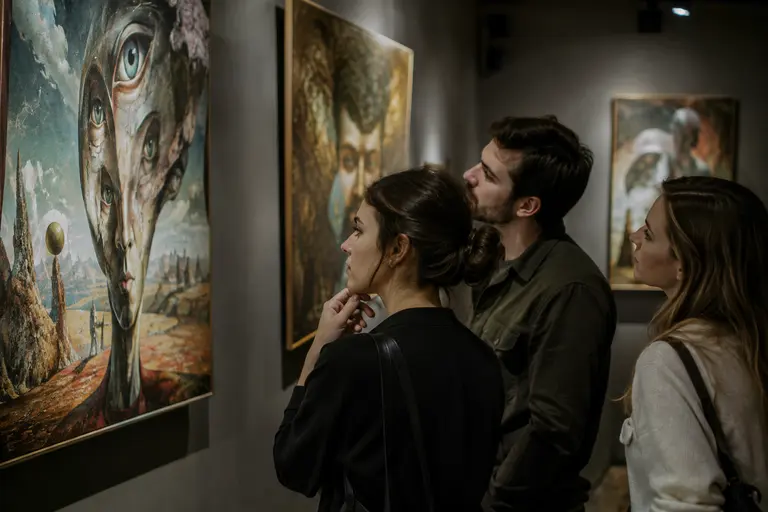
Reading Surrealism In Austin well means resisting two easy mistakes. One mistake is to call every strange image surreal and stop there. The other is to force every image into a fixed symbolic reading. The stronger approach is to ask how the work changes the rules of realism: what object feels displaced, what body feels unresolved, what scene feels staged like memory rather than documentation, and what emotional pressure the image creates.
- Ask which familiar element anchors the image: figure, food, animal, tool, room, or horizon.
- Notice where the image becomes unstable: scale, gesture, placement, violence, emptiness, or symbolic repetition.
- Separate supported facts from interpretation, especially if an artist statement or wall text is not available.
- Consider how costume, fantasy, and object symbolism overlap with broader visual culture, including related discussions at fantasy fashion and costume culture.
For artists and independent sellers, the exhibition also offers a rights-conscious lesson. It is possible to learn from how painters build mood, symbol, and visual tension without copying a living artist’s specific imagery or presenting imitation as original authorship. That distinction is especially relevant for creators working near fashion, cosplay, decor, or gift commerce, where visual influence can become too direct if not handled with care.
Surrealism In Austin After October 25, 2026
Surrealism In Austin, as seen through Everything Is a Little Surreal, is best understood as a temporary but concentrated viewing opportunity rather than a sweeping claim about the city’s art scene. The show was ongoing on October 25, 2026, and its scheduled closing date was November 29, 2026. Its documented value lies in the artists gathered, the way their works pressure realism, and the clear presence of dream logic, psychological allegory, and symbolic narrative within contemporary painting.
The most useful reading is cautious and close. Beatrez, Fox, Fung, Kolsrud, Cartier Lucy, Smith, and Whitehead are not presented here as interchangeable artists. The exhibition’s interest comes from difference held under a shared title. A fish can suggest relic and living form. A broom can act like a sign. A still life can turn quietly violent. A body-like abstraction can remain unresolved. Taken together, those moves make Everything Is a Little Surreal a strong prompt for thinking about how contemporary exhibitions can keep surrealist energy active without reducing it to spectacle.