

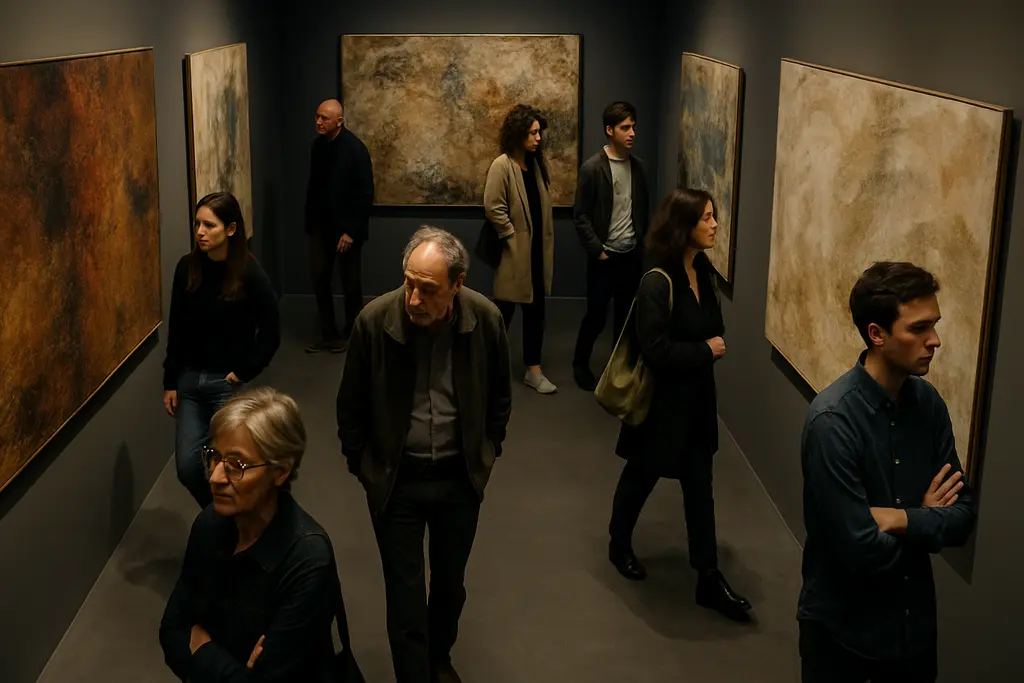
The Brice Marden Exhibition, I Am Plane Image, opened at Gagosian’s West 21st Street gallery in New York on September 15, 2026, and is scheduled to run through December 12, 2026, according to Vasili Kaliman’s exhibition note. Its emotional force does not appear to rest on drama, spectacle, or a tidy storyline. Based on the research available, the show asks viewers to slow their pace and stay with paintings that build feeling through surface, scale, color, line, and delay.
That delay matters for contemporary art because many current exhibitions compete with fast image culture, short attention spans, and immediate documentation. Marden’s work, as described in the research, moves in a different register. The paintings reward time spent at varying distances. They invite a viewer to notice how pigment shifts, how lines hold tension, how a monochrome field can feel quiet without feeling empty, and how a large canvas can affect the body before the mind settles on interpretation.
The show has also been described as the first major New York presentation of Marden’s painting in 20 years, following a major city retrospective in 2006, as reported by New York Art Life. That gap gives the exhibition a retrospective charge without making it only a memorial or career survey. It becomes a way to read how Marden’s long attention to plane, touch, and restraint still speaks to artists and viewers working amid far noisier visual conditions.
Why The Brice Marden Exhibition Feels Slow
Brice Marden Exhibition As A Viewing Test
The Brice Marden Exhibition feels slow not because the paintings are inactive, but because their activity is often withheld from a quick glance. Research notes on the exhibition describe critics focusing on color, texture, layering, and light as qualities that reveal themselves through time and distance. That is an emotional strategy as much as a formal one. The viewer is asked to give up the search for an instant payoff.
In a gallery context, this can produce an unusual kind of pressure. A painting that resists rapid viewing can make the viewer aware of their own impatience. Standing before a quiet surface, one may start by wondering what is missing, then begin to notice what is present: small tonal changes, marks beneath marks, pressure in the paint, and shifts caused by the room’s light. The emotional impact comes from that conversion of attention.
Stillness Without Emptiness
Marden’s early monochrome paintings, as described in the research, have been linked by critics to separation, memory, and landscapes encountered through travel. That reading should be handled with care; a painting’s emotional effect cannot be reduced to biography alone. Still, the research supports the idea that works such as Nebraska from 1966 carry more than formal interest. The fact that it was inspired by a road trip through the Midwest and remained in Marden’s personal collection throughout his life gives the work a particular intimacy.
Stillness in this context is not blankness. It is a field where feeling can gather without being named too quickly. For contemporary viewers used to art that announces its subject directly, such restraint can be disarming. The paintings do not tell viewers what to feel. They create conditions in which feeling becomes harder to avoid.
Scale, Surface, And Emotional Distance
Large Works And Bodily Attention
Large-scale works are central to the exhibition’s reported impact. The research identifies Only from 2009–2011 as roughly 96 by 144 inches, made in oil and graphite on linen. That scale changes the viewer’s relation to the image. A work of that size is not simply seen; it is encountered. The body adjusts to it, and the eye has to choose between scanning the whole and studying the surface up close.
This is where the Brice Marden Exhibition makes scale feel emotional rather than merely impressive. A large painting can dominate a room, but Marden’s surfaces appear to ask for quiet proximity. The viewer may feel pulled toward the paint, then pushed back to understand the structure. That push and pull creates a measured tension: intimacy at the surface, distance in the composition.
Materials That Change With Looking
The research emphasizes Marden’s use of layered oil, beeswax, and turpentine, along with subtle pigment variation. Those materials matter because they make the painting responsive to light and angle. A viewer moving a few steps can see a surface alter without the work becoming theatrical. That small perceptual shift can feel deeply personal, as if the painting is changing because the viewer has changed position.
For artists thinking about contemporary abstraction, this is a demanding lesson. Emotional weight does not always require narrative image, bright contrast, or assertive gesture. It can emerge from sustained handling, limited means, and surfaces that ask the viewer to participate through attention. Readers interested in related abstraction coverage may find a useful comparison in this discussion of the Stanley Boxer exhibition, where material presence also carries interpretive force.
Contemporary Art After Slow Looking
Against The Quick Read
One of the clearest contemporary stakes of I Am Plane Image is its resistance to the quick read. The research describes critics responding to awe, stillness, and intimacy, especially in late multi-panel works such as The Propitious Garden of Plane Image, Third Version from 2000–2006. Those responses suggest that Marden’s paintings do not simply ask viewers to understand abstraction; they ask viewers to change tempo.
That tempo is not a minor curatorial detail. In contemporary art, where documentation can sometimes precede deep experience, a slow painting places pressure on the habits around it. A phone image may record color and outline, but it cannot fully capture the felt sequence of standing, waiting, stepping closer, backing away, and watching a surface shift. The emotional impact lies in that sequence.
Liminal Feeling And Uncertainty
Research notes also point to tension and liminality in works such as 4 (Bone) from 1987–88, where critics have located energy in ghostly surfaces, erasures, and textures rather than bold gesture. That is a useful way to think about Marden’s place in contemporary art. The work can feel clear and uncertain at the same time. It offers structure, but not closure.
This balance matters because many strong contemporary artworks operate through ambiguity. Marden’s example suggests that uncertainty need not be evasive. It can be disciplined. It can be built through decisions about touch, edge, layering, and the relation between line and field. The emotional response is not confusion for its own sake; it is a controlled encounter with what cannot be settled at once.
How The Exhibition Frames Marden’s Contribution
Six Decades Without A Simple Arc
The research states that the survey spans work from the 1960s through 2023 and connects with a companion catalogue raisonné of paintings from 1961–2023, edited by Tiffany Bell. It also notes that nearly 500 paintings are documented, including almost 90 previously unpublished works and more than 70 works not publicly exhibited before. Those figures, if read carefully, point to the scale of the project rather than a simple claim of final authority.
A six-decade presentation can tempt viewers to search for a neat progression: early monochrome, later line, late synthesis. The emotional experience described in the research seems less tidy. The early works can feel private and compressed. The larger late works can feel open, sensory, and spiritual in tone. Yet both appear to share a concern with how painting holds experience without explaining it away.
Context Without Reducing The Work
Respectful criticism has to avoid turning an artist’s work into a single mood. The Brice Marden Exhibition appears to generate awe, stillness, intimacy, and uncertainty, but those words are not labels that solve the paintings. They are entry points. A viewer may feel calm before one work and unsettled before another. A critic may emphasize spiritual resonance, while another may attend to material procedure.
That openness is part of Marden’s continuing relevance. His paintings offer contemporary art a model of feeling that is not sentimental and not detached. They show how emotion can live inside restraint. For broader arts and culture reading across the same network, explorations are available at Nextclues, where related topics are covered in an extensive editorial range.
Brice Marden Exhibition And Contemporary Feeling
The Brice Marden Exhibition is best understood as an argument for patient perception. Its emotional impact, as supported by the available research, comes from paintings that slow the viewer down, ask for bodily attention, and make surface feel active without becoming loud. The exhibition’s importance for contemporary art is not that it provides a fixed lesson for every painter or viewer. It shows that abstraction can still create feeling through quiet means.
On October 20, 2026, while the show is still within its scheduled New York run, the most cautious reading is also the strongest: I Am Plane Image has been framed by critics as a major occasion for reassessing Marden’s painting through time, scale, and sensation. Its emotional power lies in the way it makes looking feel earned. In a period when images often move quickly past us, these works ask viewers to remain present long enough for perception to become feeling.