The 2026 IPPA Piano Pedagogy Conference gives piano students and teachers a useful reminder: technique is not a collection of vague instructions about “relaxing,” “playing evenly,” or “using better hands.” Technique becomes meaningful only when it turns into practical practice tasks students can repeat, measure, and understand.
The International Piano Professionals Association held its 2026 Piano Pedagogy Conference from July 17–19, 2026, at the University of Kansas School of Music in Lawrence. The official conference page described the event as focused on bridging technical foundations with the evolving needs of the modern pianist, with pedagogy presentations, lecture recitals, panel discussions, masterclasses, social events, and a “Piano Nerd-Out” round table on detailed teaching questions. The conference was led in connection with Scott McBride Smith at the University of Kansas School of Music.
For kaygranger.com readers, the practical lesson is simple. A conference about pedagogy should not stay in the language of teachers. Students can use the same ideas to make daily practice clearer: identify the motion, isolate the musical problem, test the sound, and turn teacher feedback into a repeatable routine.
Why Technique Needs To Become A Practice Task
Many students hear technical advice in broad language. They are told to use arm weight, rotate, relax, curve the fingers, play from the wrist, or keep the sound even. Those ideas may be valuable, but they are too general unless the student knows what to do at the piano tomorrow.
That is why the 2026 IPPA focus matters. The official 2026 IPPA Piano Pedagogy Conference page framed the event around technical foundations and modern pianistic needs. In student language, that means technique should help solve real playing problems: uneven scales, tense octaves, heavy chords, unclear articulation, weak voicing, or unreliable jumps.
A practical technical assignment should name the issue and the action. Instead of “fix your wrist,” a teacher might say, “Play the two-note slur slowly and let the wrist release after the second note.” Instead of “relax,” the assignment might say, “Stop after each four-note group and check that the thumb is not gripping.”
That kind of instruction gives the student a way to practice, not just a concept to remember.
What Students Can Learn From Pedagogy Conferences
A pedagogy conference may seem distant from the average practice room, but it exists because teachers are trying to make learning more effective. The University of Kansas piano pedagogy program describes piano teaching as more than being an excellent player; it includes advanced pedagogy, practicum work, seminars, private lessons, and teaching experience through the KU piano pedagogy program.
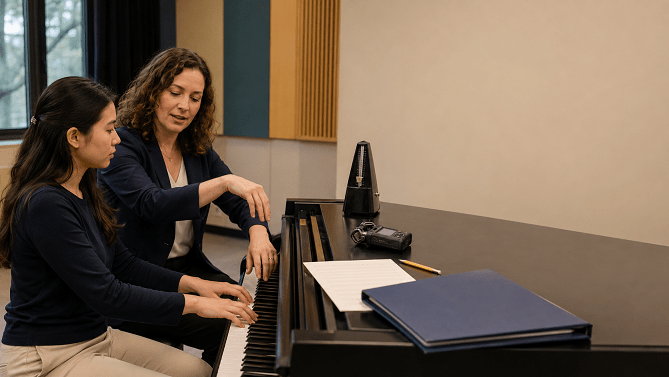
That distinction matters. Good teaching is not only demonstrating beautiful playing. It is translating expert knowledge into steps a student can actually follow.
Students can borrow that mindset. When a piece feels hard, ask a teacher-style question: what exact skill is missing? Is the problem rhythm, fingering, rotation, balance, hand crossing, reading, memory, or sound control? Once the problem is named, the practice session becomes less emotional and more useful.
This also reduces frustration. A student who says, “I am bad at this piece,” has no path forward. A student who says, “My left hand rushes when the right hand has repeated chords,” has a practice target.
Turn Rotation Into A Small Experiment
One detail highlighted in IPPA’s conference language was a “Piano Nerd-Out” round table that included detailed topics such as the biomechanics of rotation. For students, rotation should not become a complicated lecture. It should become a small experiment.
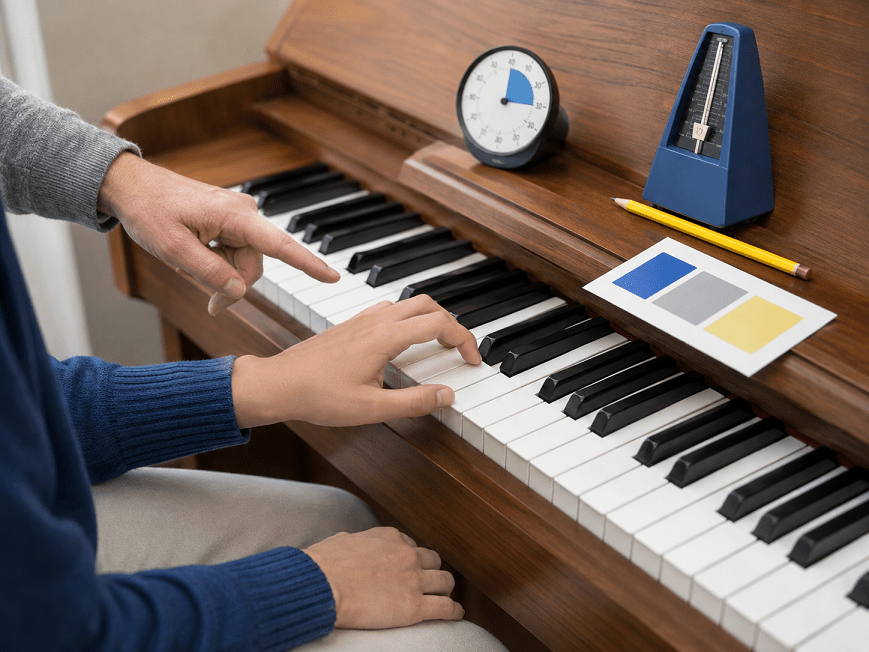
Try this with a simple five-finger pattern. First, play it stiffly and notice how the hand feels. Then play it slowly while allowing a tiny side-to-side forearm motion that helps each finger arrive without squeezing. The point is not to exaggerate the movement. The point is to notice whether the sound becomes easier and the hand feels less stuck.
This works especially well in Alberti bass patterns, broken chords, repeated-note figures, and scale passages where the thumb tends to tighten. The student should practice in short groups, pause, and check the hand.
A useful rule is: if the motion makes the sound clearer and the body calmer, it is helping. If the motion becomes theatrical or distracting, it is too much.
Make Technique Musical From The Beginning
Technique should not be separated from sound for too long. A student can play a technically “correct” pattern and still sound mechanical. That is why every technical practice block should include a musical question.
For scales, ask: can the line grow toward the top and release on the way down? For chords, ask: can the top note sing above the inner notes? For repeated notes, ask: can the rhythm stay alive without pounding? For staccato, ask: is the sound light, clear, and controlled?
This turns technique into musicianship. The student is not only training fingers. They are training decisions.
Scott McBride Smith’s University of Kansas profile identifies him as the Cordelia Brown Murphy Professor of Piano Pedagogy and notes his focus on national issues of teacher training and piano pedagogy through the KU faculty profile. That kind of pedagogy focus points back to the student’s daily question: how does a technical idea become better teaching, better practicing, and better sound?
Use Short Technical Blocks Instead Of Endless Drills
Technical practice should be focused, not endless. A student does not need 40 minutes of unfocused scales if the real issue is one tense thumb crossing. A better plan is a short block with one goal.
A 10-minute technical block might look like this: two minutes to identify the motion, three minutes to practice slowly, two minutes to vary rhythm, two minutes to connect it to the piece, and one minute to record or self-check. That is more useful than repeating a scale while thinking about something else.
For intermediate players, technical blocks can be tied directly to repertoire. If a Chopin passage needs rotation, practice a miniature version of that motion before returning to the piece. If a Mozart passage needs clear articulation, practice the touch pattern on a smaller group first.
Technique should serve the music on the stand.
What Teachers Should Emphasize After IPPA 2026
Teachers can use the 2026 IPPA conference as a reminder to make technical language concrete. If a student cannot explain the assignment at home, the assignment may need clearer wording.
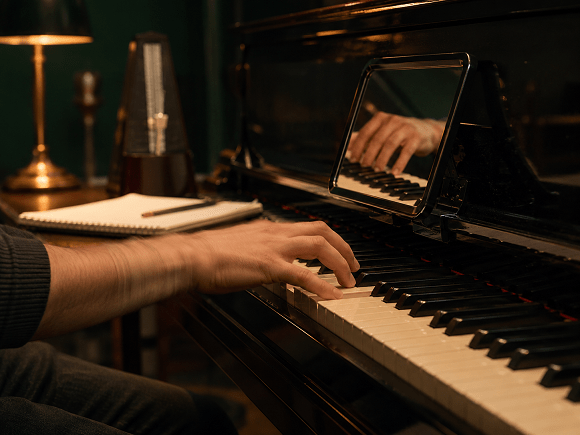
Instead of saying, “work on technique,” teachers can assign one physical action, one sound goal, and one stopping rule. For example: “Practice the broken-chord pattern in two-measure groups, keep the wrist loose during the thumb turn, and stop if the hand tightens.”
That gives the student responsibility without leaving them alone with abstract advice.
Teachers can also ask students to report what worked. Did the motion feel easier? Did the recording sound clearer? Did the passage become more reliable? Technical progress should be observed, not guessed.
Why Practical Technique Builds Confidence
Students often think technique is a mysterious talent some pianists naturally have. Practical pedagogy teaches the opposite. Technique is a set of learnable solutions for musical problems.
That is the value of the 2026 IPPA Piano Pedagogy Conference as a practice-tips topic. It shows that modern piano teaching is not just about naming ideals. It is about turning those ideals into actions students can use: rotate here, release there, listen for this note, divide the passage, record the result, and adjust.
For young pianists, adult beginners, and teachers, the takeaway is the same. Do not leave technique in abstract language. Turn it into a practice task. Then connect that task to sound.
That is how technical advice becomes real piano progress.