
Piano lessons can benefit from visual art without turning music study into a loose mood exercise. Used carefully, current exhibitions give students concrete ways to think about phrasing, contrast, process, rhythm, attention, and care. The goal is not to claim that a painting directly “explains” a piece of music. A better goal is to use visual art as a disciplined prompt for listening and practice.
As of October 23, 2026, two exhibition examples from university museums offer useful models for teachers. At NYU’s Grey Art Museum, Making Music: Helen Frankenthaler Prints from the New York University Art Collection opened on September 9, 2026, and runs through July 3, 2027. The exhibition features nine prints from 1965 to 2000 and examines how music and dance influenced Frankenthaler’s visual style, according to the Grey Art Museum announcement. At the Spencer Museum of Art, Looking After: Art and Care in Education Across Kansas opened on August 18, 2026, and features more than 80 works used in K–12 education, with attention to care, mentorship, and learning, according to the Spencer Museum of Art.
Why Visual Art Belongs In The Lesson Room
Cross-Sensory Thinking Without Overclaiming
Music teachers often use images informally: a student may be asked to imagine a darker color for a bass line, a brighter edge for a staccato passage, or a long brushstroke for legato. Those comparisons can help because they move the student away from note-counting and toward sensation, timing, and shape. Still, the comparison should stay modest. A print, painting, or sculpture does not replace score study, technical work, or historical context.
The strongest teaching use is diagnostic. If a student plays every phrase with the same weight, a visual artwork can introduce the idea of foreground and background. If a student rushes through transitions, an artwork can invite questions about spacing, pause, and balance. The teacher is not asking the student to “play the artwork.” The teacher is asking the student to notice how structure affects perception.
What Students Can Observe
Useful visual observations include density, repetition, contrast, contour, proportion, and directional movement. Each of these has a musical parallel. Density can suggest chordal weight. Repetition can suggest motif work. Contrast can suggest changes in register or articulation. Contour can suggest melodic line. Proportion can guide phrase length. Directional movement can help a student hear whether a passage leans forward, settles, or resists closure.
Using Current Art To Shape Piano Lessons
Start With One Question
The safest way to bring an exhibition into teaching is to begin with one clear question. For piano lessons, the useful question might be: “Where does the phrase feel open, and where does it feel resolved?” A student can answer that question by looking at an artwork, then by returning to the score and marking phrase arrivals, suspensions, and releases.
This keeps the activity musical. The exhibition becomes a prompt for more precise listening, not a decorative sidebar. Teachers can choose short tasks: compare two measures with two areas of an image, identify a repeated visual element and a repeated musical motive, or ask the student to describe how a left-hand accompaniment supports or interrupts a melody.
Keep The Score Central
Young students and adult beginners alike can become distracted if the activity feels too open. The printed score should remain the reference point. A visual prompt is most productive when it sends the student back to rhythm, fingering, pedaling, voicing, or form. For example, a student who describes an image as “spread out” should then locate a musical passage where spacing matters: wide intervals, rests, registral distance, or delayed harmonic arrival.
From Frankenthaler To Musical Phrasing
Piano Lessons Prompt: Rhythm As Line
The Frankenthaler exhibition is especially relevant because the museum’s description connects the prints to music and dance. That connection gives teachers a historically grounded starting point, while still leaving room for careful student response. Since the exhibition includes prints from 1965 to 2000, a teacher can frame the lesson around change over time: how does a musical idea return altered, lighter, denser, or placed in a new register?
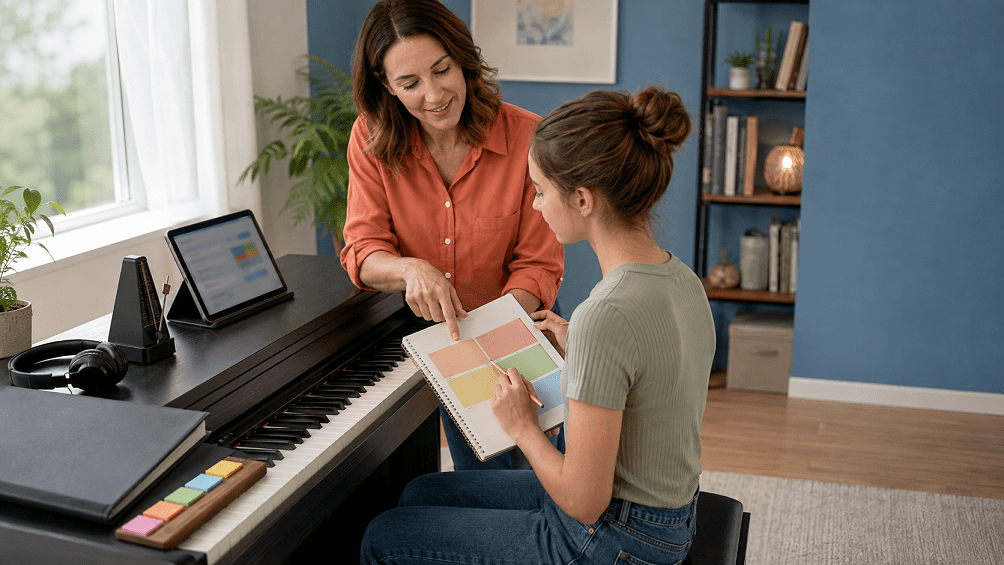
One practical task is to ask a student to draw a simple line for a phrase before playing it. The line may rise, fall, linger, or break. Then the student plays the phrase and evaluates whether the sound matched the drawn contour. This is useful for students who understand note accuracy but struggle to plan breath and direction. The drawing should not become a performance rule. It is a rehearsal tool.
Teachers can also use Frankenthaler’s connection to dance as a way to discuss pulse. Dance does not mean every beat is heavy. A dancer uses weight, suspension, landing, and release. Piano students can apply the same vocabulary to accompaniment patterns: which beats carry weight, which beats pass through, and which gestures need a clear landing?
Care, Attention, And Student Practice
Learning As Maintenance
The Spencer Museum exhibition offers a different teaching angle. Its focus on works used in K–12 education, and on care, mentorship, and learning, can help piano teachers talk about practice as maintenance rather than punishment. Many students think practice means proving they are good enough. A care-based model frames practice as returning attention to a musical object over time.
This matters in lessons because students often treat mistakes as moral failures. A teacher can redirect the language: the passage is not “bad,” it needs care. The left hand is not “hopeless,” it needs slower coordination. The memory slip is not evidence of failure, it is a sign that the structure needs clearer landmarks. That shift can make feedback more exact and less discouraging.
Mentorship In The Studio
Mentorship also fits the piano studio. A teacher does not merely assign pieces and correct wrong notes. The teacher models how to listen, how to repeat without panic, and how to evaluate sound. A student learns that care includes the body, the instrument, the score, and the surrounding community. Even a small home practice session can reflect that standard: sit well, listen closely, repair one problem, and end with a musical gesture.
Practical Cross-Arts Exercises
Five Studio Activities
These activities work best when they are brief and tied to a clear musical outcome. They can be used with children, teens, or adult amateurs, with adjustments for repertoire level.
- Phrase contour sketch: Draw the shape of a four-measure phrase, then play it with matching direction and breath.
- Foreground and background: Identify the visual focus in an artwork, then voice melody and accompaniment with a similar sense of priority.
- Repetition study: Find a repeated visual element, then compare it with a repeated motive in the score.
- Texture comparison: Describe an image as sparse, dense, smooth, or layered, then apply one term to touch or pedaling.
- Care practice: Choose one weak measure and give it five minutes of calm, focused repair rather than playing the whole piece again.
Teachers exploring broader arts education resources might find a related site, robsonic, useful for comparative reading on creative culture. In the studio itself, the priority should stay clear: every arts connection should help the student hear, practice, or perform with more intention.
Piano Lessons And Current Exhibitions
A Careful Teaching Model
Current exhibitions can give piano lessons fresh points of entry, but the best results come from restraint. Teachers should avoid vague claims that visual art automatically improves musical expression. Instead, they can use exhibitions as structured prompts: one image, one question, one passage, one audible goal.
The Frankenthaler exhibition supports discussions of movement, rhythm, dance, and visual composition. The Spencer Museum exhibition supports discussions of learning, mentorship, and care. Together, they show how visual art can strengthen music education when the teacher keeps the activity grounded in listening and practice.
For students, the benefit is not simply inspiration. It is a clearer path from perception to sound. They see contrast, then voice contrast. They notice spacing, then shape silence. They consider care, then repair a passage patiently. That is a practical and respectful way to connect current art exhibitions with the daily work of becoming a more attentive pianist.