MTNA’s July 2026 studio webinar may sound like a business topic for teachers, but piano students can learn something important from it: better practice often starts with better boundaries. The Music Teachers National Association listed “Blueprint for Success: Running a Thriving 21st-Century Studio” as a July 24, 2026 webinar presented by Amy Chaplin and Davis Dorrough, NCTM. MTNA described the session as focused on smart systems, clear communication, efficient business practices, and sustainable studio management.
For kaygranger.com readers, the student-facing lesson is clear. A well-run studio is not only about tuition policies, calendars, and teacher workflow. It also shapes how students practice at home. When expectations are clear, students know what to practice, when to stop, how to ask questions, and how to avoid turning every session into a vague attempt to “get better.”
Practice boundaries do not make piano study less serious. They make it more sustainable. A student who has a clear assignment, a realistic weekly plan, and a defined stopping point is more likely to return to the piano tomorrow. A student who treats practice as an endless obligation may burn out, rush, or repeat mistakes without listening.
Why A Studio Webinar Matters To Piano Students
MTNA’s official 2026 webinars page describes the July 24 session as a studio-management webinar, not a student practice clinic. Still, its core ideas translate directly into home practice. MTNA says running a studio takes more than great teaching; it requires smart systems, clear communication, and a willingness to adapt. Those same principles are exactly what many students need at the piano bench.

A student’s practice problem is often not laziness. It is ambiguity. The student sits down and does not know where to begin. Should they warm up? Should they play the whole piece? Should they fix the hard measure? Should they repeat what went wrong in the lesson? Should they stop after 20 minutes or keep going until everything feels better?
Boundaries answer those questions before the session begins. A good boundary might be: practice one assigned passage for 10 minutes, then stop and record it. Another might be: do not repeat a mistake more than three times without changing the method. Another might be: finish with one piece you can play musically so practice ends with confidence.
This is why a teacher-studio webinar can become a student practice lesson. Studio systems are not separate from musicianship. They create the conditions where musicianship can grow.
Practice Boundaries Are Not Practice Limits
Some students hear the word “boundary” and imagine less ambition. That is not the point. A boundary is not a ceiling. It is a frame. It tells the student what the session is for and what it is not for.
A 20-minute practice session with a clear frame can be more effective than a 90-minute session that wanders. The student who knows the goal can listen more closely. The student who is only trying to fill time may drift into autopilot.
A useful boundary includes three parts: task, time, and stopping rule. The task says what the student will work on. The time says how long the student will stay with it. The stopping rule says when the work is complete enough for today.
| Practice Boundary | What It Means | Student Example |
|---|---|---|
| Task Boundary | Define the exact musical problem | “Fix the left-hand rhythm in measures 9–12.” |
| Time Boundary | Limit the session or block | “Work for 12 focused minutes, then pause.” |
| Repetition Boundary | Avoid mindless looping | “After three failed tries, slow down or change hands.” |
| Communication Boundary | Know when to ask for help | “Mark the question for next lesson instead of guessing.” |
| Recovery Boundary | Stop before tension becomes the habit | “Take a break when wrists tighten or focus drops.” |
This table matters because students often think effort means doing more. Better practice usually means doing the right thing with more attention.
Clear Assignments Reduce Practice Anxiety
A student who leaves a lesson with “practice this more” has not received a real practice plan. That kind of assignment creates anxiety because it gives pressure without direction. A better assignment tells the student what to do first, how to do it, and what counts as progress.
Amy Chaplin’s own speaking calendar confirms that “Blueprint for Success: Running a Thriving Studio in the 21st Century” was presented as an MTNA member webinar on July 24, 2026, after appearing at the MTNA National Conference in Chicago on March 23, 2026. That repeat appearance suggests the topic had broad relevance for independent music teachers, especially those trying to build clearer systems for students and families through Amy Chaplin’s speaking calendar.
Students benefit when teachers turn studio systems into practice language. Instead of “work on your piece,” the assignment can say: warm up with the scale pattern, clap the rhythm in the B section, practice the left hand alone slowly, then play the first eight measures with pedal only after the notes are secure.
That clarity lowers stress. The student no longer has to invent the practice process at home. They can focus on listening and improving.
Parents benefit too. A parent does not need to hover or guess whether the child practiced correctly. The written assignment becomes a shared reference point. The home becomes less tense because expectations are visible.
Students Need A Weekly Practice Agreement
A weekly practice agreement is not a punishment chart. It is a simple plan that connects the lesson to real life. Students have school, work, sports, family, homework, travel, and fatigue. A practice plan that ignores the week’s actual schedule will fail even if it looks impressive.
A better agreement asks: which days are realistic? Which days need short sessions? Which day can handle deeper work? What should happen the day after the lesson? What should happen before the next lesson?
This is where studio boundaries become student boundaries. The teacher sets expectations. The student participates in shaping the plan. The parent, when involved, understands what support should look like.
A beginner might practice four short sessions instead of one stressful marathon. An intermediate player might divide the week into technique, repertoire, sight-reading, and recording review. A teen preparing for a performance might schedule run-throughs only on certain days to avoid fatigue.
The agreement should be specific enough to guide practice but flexible enough to survive real life. A failed practice plan is often not a character flaw. It may simply be too unrealistic.
Better Boundaries Help Students Stop Repeating Mistakes
One of the biggest practice problems is repetition without repair. A student plays a passage, misses the same note, starts again, misses it again, and keeps going. After 10 minutes, the mistake has become more familiar.
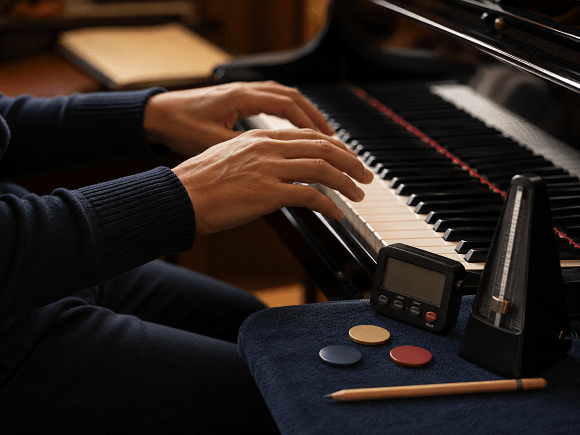
A boundary interrupts that loop. The student can decide in advance: if I miss the same passage three times, I must change the method. That change might mean slowing down, separating hands, clapping the rhythm, marking fingering, removing pedal, or practicing only two beats.
This is one reason structured practice is so powerful. Piano.org’s current practice guide emphasizes section work, metronome use, hands-separately practice, and dividing a session into clear activities such as warm-ups, repertoire, sight-reading, and theory or ear training through its structured piano practice guide. The principle matches the MTNA webinar theme: systems reduce confusion.
Students should not wait until frustration appears to change strategy. The boundary should be built in before frustration begins. Three failed tries is information. It means the current method is not working.
A student who learns this skill becomes more independent. They do not need a teacher beside them every minute. They learn how to diagnose the practice problem.
Communication Boundaries Make Lessons More Useful
A student should know what questions belong in the next lesson. Without communication boundaries, students may guess, avoid, or overpractice.
A good practice journal can include a question column. The student writes down the exact problem: “I can play the right hand alone, but hands together falls apart in measure 16,” or “I do not know whether this fingering should change before the repeat.” That is more useful than arriving at the lesson and saying, “I had trouble.”
Teachers can encourage this by treating questions as part of the assignment. Parents can help by asking, “What question should you bring to your teacher?” rather than “Why can’t you play it yet?”
The MTNA webinar language about clear communication matters here. Studio communication is not only about emails and policies. It is also about teaching students how to communicate musical problems. A clear question saves lesson time. It helps the teacher respond precisely. It helps the student feel seen rather than judged.
Communication boundaries also reduce digital confusion. A student does not need to search random videos every time a problem appears. Sometimes the best move is to mark the issue and ask the teacher.
Boundaries Protect Physical And Mental Focus
Piano practice can become counterproductive when students ignore fatigue. Tight wrists, stiff shoulders, shallow breathing, and mental fog are not signs of discipline. They are signs that the session needs adjustment.
A recovery boundary might be simple: stop for two minutes when the hands tighten. Stand up after 20 minutes. Do not practice fast octaves when tired. Do not keep repeating a passage after focus has dropped. These are not excuses. They are ways to prevent bad habits from becoming permanent.
MTNA’s 2026 webinar page also lists an April 3 session by Pallavi Mahidhara, “The Conscious Artist: A Path to Mental & Physical Wellbeing,” focused on mental health awareness, breath work, body alignment, injury prevention, and sustainable artistry. That broader MTNA webinar context reinforces a key point for students: practice systems should support musicians, not wear them down.
A student who practices with boundaries may actually practice more consistently over time. The session feels manageable. The body feels safer. The mind knows what success looks like.
That is especially important for children and teens. They need to learn that serious music study does not require ignoring discomfort. It requires noticing, adjusting, and returning with better focus.
What Parents Should Do Differently
Parents often want to help but accidentally turn practice into a daily conflict. The boundary lesson applies to parents too. Their job is not to become a second teacher unless the teacher has asked for that role. Their job is to support the conditions for practice.
A parent can help by creating a predictable practice window, reducing interruptions, checking the assignment notebook, and asking what the practice goal is. A parent can also help by respecting the stopping point. If the assignment says 20 focused minutes, adding another 25 minutes of pressure may not improve the work.
Parents should avoid vague judgments such as “That sounded bad” or “You need to practice more.” Better questions include: What section did your teacher assign? What did you improve today? What question should you ask next lesson? Did you stop before your hands got tense?
These questions match the boundary mindset. They focus on process, not panic.
For younger students, parents can also help mark practice blocks with a timer. The timer should not feel like a threat. It should make the session finite and understandable. When a child knows the practice block has a beginning and ending, resistance often decreases.
What Teachers Should Emphasize After The Webinar
Teachers can use the July 2026 MTNA webinar as a reminder to make practice expectations visible. A studio policy may explain tuition, cancellations, and communication, but a practice policy can explain how students should work at home.
That does not mean every student needs the same routine. In fact, one-size-fits-all practice assignments often fail. A seven-year-old beginner, a teenage competition student, and an adult returning to piano after 20 years need different boundaries.
Teachers can create assignment language that separates tasks. For example: “Technique,” “New Notes,” “Problem Spot,” “Musical Detail,” “Review,” and “Question For Lesson.” This gives students a map. It also makes it easier for parents to understand progress.
Teachers should also tell students when not to continue. If a passage becomes tense, if the pedal is hiding mistakes, if the rhythm collapses, or if the student is guessing notes, the assignment should say what to do next. Stop, slow down, separate hands, circle the problem, or bring the question to the lesson.
Boundaries make the teacher’s expectations more humane and more precise.
A Better Student Practice Routine Built From Boundaries
A boundary-based practice routine does not need to be complicated. It simply needs to define the session before the student begins.
A 30-minute student routine might work like this: five minutes of warm-up or technique, 10 minutes on the hardest assigned passage, five minutes on rhythm or counting, five minutes on musical shaping, and five minutes recording or reviewing. Each block has a purpose. The student does not drift.
A younger beginner might use 12 minutes: two minutes of note review, four minutes of the assigned pattern, four minutes of the piece, and two minutes playing something familiar. An adult student might use a 25-minute evening routine that includes one technical task, one repertoire task, and one review piece.
The exact timing is less important than the principle. Practice should be bounded enough that the student knows what to do and when to stop. That is how a studio-management idea becomes a musical habit.
Why Practice Boundaries Build Long-Term Confidence
Piano confidence does not come from pretending every session went perfectly. It comes from knowing how to recover when practice gets messy. Boundaries teach that recovery.

A student who knows how to slow down after mistakes is less likely to panic. A student who knows when to stop is less likely to associate piano with exhaustion. A student who knows how to write a question for the teacher is less likely to hide confusion. A student who has a weekly plan is less likely to depend on guilt for motivation.
That is the deeper lesson from MTNA’s July 2026 studio webinar. Smart systems, clear communication, and sustainable boundaries are not only business tools for teachers. They are practice tools for students.
Better boundaries help students practice with purpose. They protect attention. They reduce conflict at home. They turn lessons into clearer conversations. They make progress visible without making practice feel endless.
For piano students, the best boundary may be the simplest one: know the job before you start. Then do that job with attention, stop before the work becomes careless, and bring your best question to the next lesson.