

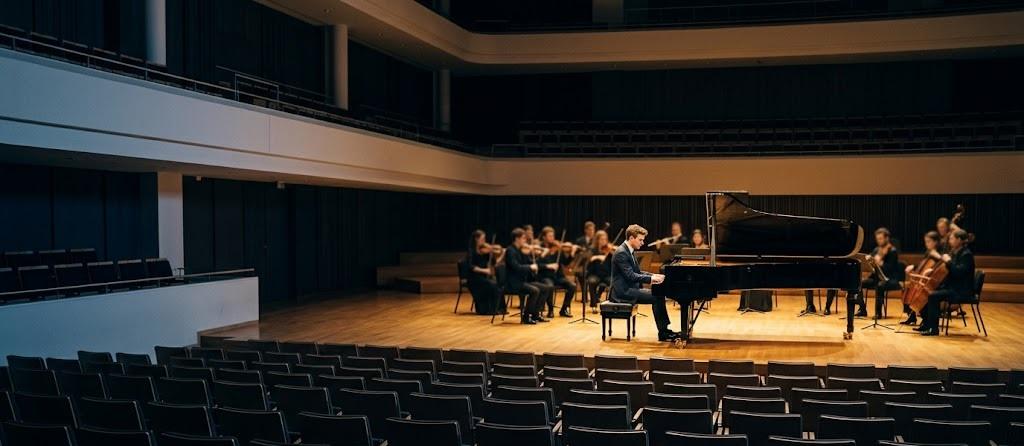
The Dallas International Piano Competition still matters for young concert pianists because it tests the exact skills that separate strong solo players from stage-ready concerto artists: repertoire judgment, orchestral awareness, pressure control, public communication, and the ability to project a musical identity in front of a jury and a live audience. The 2026 finals, held June 23 at Moody Performance Hall in the Dallas Arts District, made that point clearly. Three finalists performed full concertos with the Dallas Chamber Symphony, with Jim Stopher conducting, and the event ended with Jialin Yao named first-prize winner and Audience Choice winner.
For students following competitive piano from a distance, Dallas is useful because it is not only a medal event. It is a practical model for how a young pianist moves from practice-room control to concert-hall responsibility. The official Dallas International Piano Competition schedule showed a progression from quarterfinal concerto performances with piano accompaniment at Murchison Performing Arts Center to a final round with orchestra at Moody Performance Hall. That structure matters for developing pianists. It rewards preparation, adaptability, stamina, and the ability to communicate a large-scale musical argument under changing conditions.
Why Dallas Tests More Than Solo Technique
A pianist can build impressive technique through études, sonatas, and recital repertoire, but concerto playing introduces a different kind of musicianship. The soloist must lead without rushing, listen without disappearing, and shape phrasing in real time with a conductor and orchestra. The 2026 Dallas final placed that skill at the center of the competition. Kamil Pacholec performed Frédéric Chopin’s Piano Concerto No. 1 in E Minor and received second prize. Miao Gao performed Sergei Prokofiev’s Piano Concerto No. 3 in C Major and received third prize. Jialin Yao performed Tchaikovsky’s Piano Concerto No. 1 in B-flat Minor and won both first prize and the Audience Choice award, according to the Dallas Chamber Symphony’s official competition finals program.

That mix of repertoire says a great deal about what young pianists must prepare for. Chopin asks for long-line lyricism, transparent passagework, and tonal elegance. Prokofiev demands rhythmic sharpness, wit, stamina, and the ability to move between bite and clarity. Tchaikovsky requires scale, projection, chordal command, and emotional architecture. These are not interchangeable tests. Each concerto exposes a different relationship between pianist, orchestra, and hall.
For a student reading the results, the lesson is not that one concerto is safer than another. The stronger takeaway is that competition repertoire must match the pianist’s artistic profile. A technically difficult piece can impress, but only if the performer can make it feel inevitable. That connects with kaygranger.com’s earlier piano competition preparation guidance: young players need a program that reveals their strengths rather than one that merely signals ambition.
How The Final Round Creates A Real Concert Standard
The Dallas format matters because the final round is public-facing. It is not just a private audition for a jury. The audience at Moody Performance Hall heard three concerto performances in one evening, with intermissions, audience voting, and a concert atmosphere. That makes the event closer to a professional engagement than a studio exam.
NBC 5 Dallas-Fort Worth reported that the Dallas International Piano Competition is hosted by the Dallas Chamber Symphony and that the 2026 final featured three pianists performing concertos with the orchestra on June 23 at Moody Performance Hall. The same report noted that the orchestra established its international instrument competitions in 2012, one year after its founding, and that the piano competition is held every other year. Richard McKay, the Dallas Chamber Symphony’s artistic and music director, said the 2026 competition drew 172 applicants and competitors from roughly 20 countries, according to NBC DFW’s competition report.
Those numbers give young pianists useful context. A competition slot is not simply a chance to “play well.” It is a chance to stand out in an international pool where many applicants already have conservatory training, performance experience, and competition records. The final round asks whether a pianist can deliver under the conditions that shape real careers: limited rehearsal time, public expectations, orchestral coordination, and a hall full of listeners with different ears.
The audience component adds another layer. A jury may reward structure, control, stylistic command, and long-term artistic potential. An audience may respond to immediacy, stage presence, emotional force, or the sense that a performer carried the room. Jialin Yao winning both first prize and Audience Choice in 2026 suggests a rare alignment between expert judgment and public response. For a young pianist, that is one of the highest-value lessons Dallas can offer: artistry must satisfy serious musical standards, but it still needs to reach people in the room.
What Young Pianists Can Learn From The Repertoire Choices
The 2026 finalist repertoire offers a compact lesson in concerto strategy. Chopin’s First Concerto can expose tone production, rubato control, and poetic pacing. Prokofiev’s Third can expose rhythmic discipline, articulation, and stamina. Tchaikovsky’s First can expose scale, dramatic timing, and the ability to make large gestures feel shaped instead of forced.
A student choosing competition repertoire should think in terms of fit, not prestige. A concerto must show technical readiness, but it must also let the pianist speak clearly. A performer who sounds natural in Chopin may not gain much by forcing a heavier concerto too soon. A pianist with rhythmic bite and a modern edge may make a stronger case through Prokofiev than through a piece that hides those gifts. A pianist with the sound and architecture for Tchaikovsky still has to prove that volume and speed are guided by musical purpose.
The Dallas event also reminds students that concerto preparation is not a last-minute layer added after solo practice. The official schedule showed quarterfinalists playing chosen concertos with piano accompaniment before the finalists advanced to the full-orchestra round. That progression means pianists must understand the orchestral part long before they reach the final. They need to know entrances, tuttis, transitions, tempo relationships, and places where the orchestra carries the argument.
For teachers, the Dallas model gives a clean teaching frame. A student preparing a concerto should practice three versions of the piece: the solo part alone, the solo part against a reduction or recording, and the solo part as a chamber conversation with imagined orchestral partners. That third version is often the difference between playing a concerto and performing one.
Why Dallas Matters In A Crowded Piano Competition Field
North Texas already has a major piano identity through the Van Cliburn International Piano Competition in Fort Worth, but Dallas serves a different role in the ecosystem. Its connection to the Dallas Chamber Symphony gives emerging pianists a recurring orchestral competition platform tied to a professional local arts institution. That structure matters for players who need more than résumé lines. They need credible chances to perform large repertoire in front of serious listeners.

The 2026 final also arrived during an unusually busy summer for Dallas, with FIFA World Cup activity bringing extra travel pressure and public attention to the city. NBC DFW reported McKay’s comments about the logistics of hosting international pianists during a period of heavier Dallas travel. For young performers, that detail may sound secondary, but it reflects a real part of concert life. Serious musicians often perform under imperfect conditions. Travel, rehearsal schedules, nerves, unfamiliar instruments, and busy cities all become part of the job.
Visit Dallas listed the finals for June 23 from 7:00 p.m. to 9:00 p.m. at Moody Performance Hall, 2520 Flora Street, with tickets priced at $29 to $54 and Jim Stopher conducting. The event description emphasized that attendees could vote for the Audience Choice Award, reinforcing the public-facing nature of the night through official Dallas event details.
That public setting gives the competition its practical value. A young pianist can win a medal in a closed setting and still struggle to build a concert identity. Dallas pushes competitors toward the harder question: can the performance hold attention as a complete musical event?
What The 2026 Results Reveal About Career Readiness
Jialin Yao’s first prize and Audience Choice recognition show how powerful it can be when technical command, large-scale repertoire, and audience connection meet in the same performance. Kamil Pacholec’s second prize with Chopin and Miao Gao’s third prize with Prokofiev also show the range of artistic pathways available to advanced young pianists. There is no single “competition sound” that guarantees success. The field rewards musicians who know what they can say clearly and can say it under pressure.
For students, the most useful takeaway is not to copy the repertoire list. It is to study the demands behind the list. Chopin asks whether a pianist can sustain elegance without sounding fragile. Prokofiev asks whether a pianist can stay sharp without sounding mechanical. Tchaikovsky asks whether a pianist can project scale without losing structure. Those are practice questions, not just performance questions.
The Dallas International Piano Competition remains relevant because it turns those questions into a real test. It places young pianists in a setting where preparation, taste, collaboration, and audience communication all count. For a developing concert pianist, that is exactly the point. The goal is not only to survive a difficult score. The goal is to make a difficult score sound like a personal, public, convincing musical statement.
Why Young Pianists Should Watch Dallas After The Medals Are Announced
The medals matter, but the deeper value of Dallas comes after the winners are named. Students can study how finalists choose repertoire, how concerto rounds are sequenced, how public audiences react, and how a pianist’s identity becomes clearer under pressure. A competition like Dallas gives young players a visible model of the bridge between conservatory excellence and professional performance life.
That bridge is where many talented pianists struggle. They may have speed, memory, and discipline, yet still need experience shaping a long concerto arc for listeners who are not grading a lesson. They may understand the score, yet still need to learn how to breathe with an orchestra. They may impress a teacher, yet still need to learn how to command a hall.
That is why the Dallas International Piano Competition still matters. It gives young concert pianists a serious target, a public standard, and a reminder that the most convincing performers do more than play the right notes. They make a case for why the music should matter in that room, on that night, for that audience.