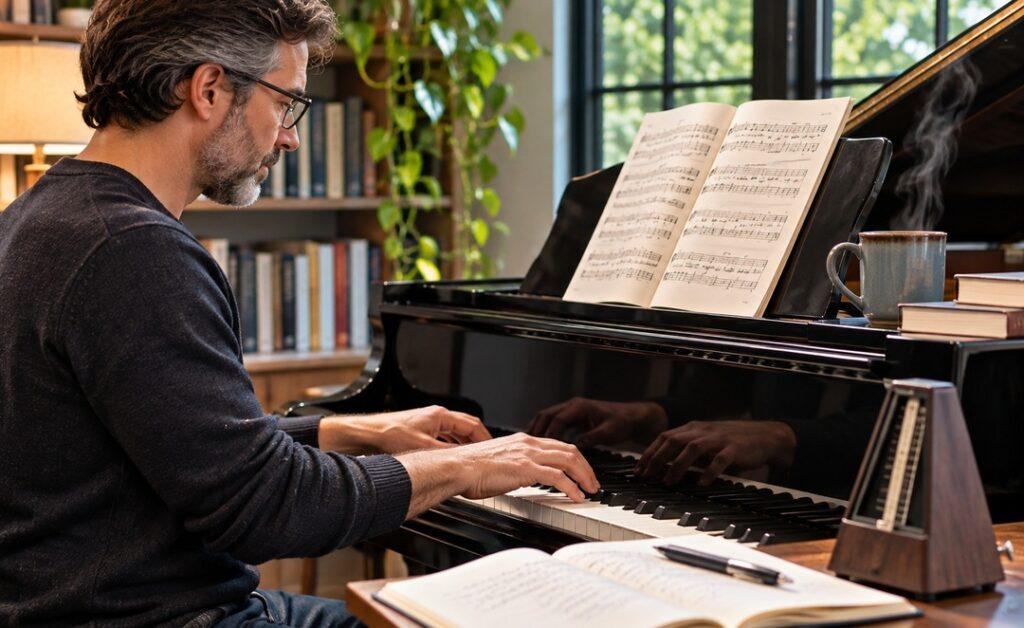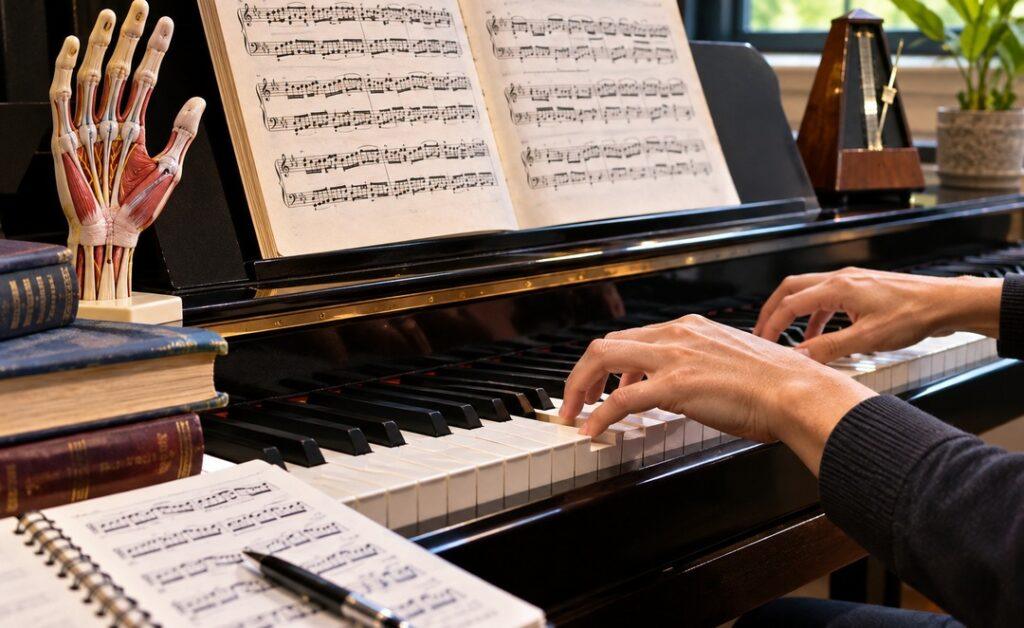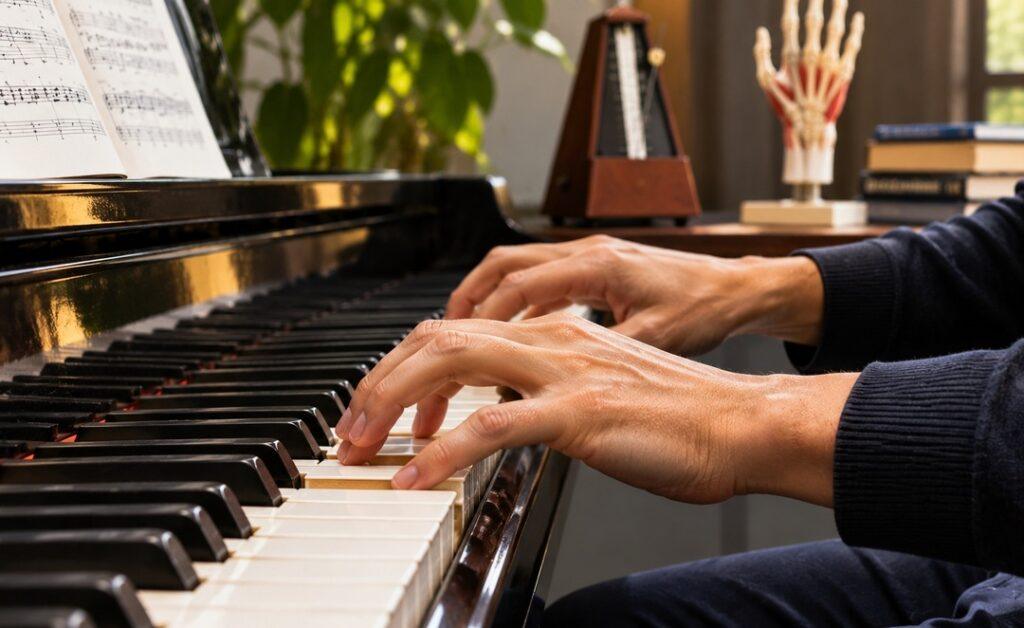


Returning to the piano as an adult—or approaching the instrument for the first time—presents a cognitive and mechanical journey markedly distinct from childhood musical education. Mature learners possess analytical reasoning, acute critical listening faculties, and clear aesthetic goals. However, adult students frequently encounter distinct physical hurdles, including entrenched musculoskeletal tension, uneven finger independence, and the cognitive friction of translating complex notation into motor actions. Navigating these challenges requires a deliberate instructional methodology that bridges biomechanical discipline, balanced repertoire sequencing, and an understanding of modern keyboard mechanics.
Adult learners frequently arrive with fixed expectations regarding early progress, often attempting advanced scores before securing core kinesthetic habits. Because adult hands have developed habitual tension patterns through decades of typing, driving, and manual tasks, forcing finger articulation without whole-arm integration quickly triggers physical discomfort. The goal of an effective adult curriculum is to transform intellectual comprehension into instinctive physical response without accumulating somatic strain.
Biomechanical Foundations and Ergonomic Posture
Efficient piano technique originates not in the small muscles of the digits, but in the balance of the entire upper torso. Adult beginners often succumb to intuitive compensatory habits, such as elevating the shoulders, collapsing the wrists, or applying downward pressure through brute muscle contraction. Over time, these habits cause rapid muscular fatigue and heighten the risk of repetitive strain injuries like tendinitis. Establishing an aligned ergonomic baseline ensures that tonal production relies on gravity and natural weight transfer rather than localized muscular tension.
The pianist should sit on the front half of the bench with both feet planted firmly on the floor to provide a grounded tripod of support. Forearms should rest roughly parallel to the floor when the fingertips touch the keytops, placing the elbow slightly forward of the torso. Key strike must be governed by flexible wrist movement and free arm weight, as emphasized in the ergonomic guidelines outlined by the Music Teachers National Association. By using the wrist as a flexible shock absorber, the player cushions each keystroke, allowing rapid kinetic rebound into adjacent melodic passages without accumulating stiffness in the flexor tendons.
Achieving true relaxation at the keyboard does not imply limp passivity. Instead, it requires dynamic equilibrium: a firm, arched hand structure supported by an active bridge at the metacarpophalangeal joints, paired with completely loose wrists, free elbows, and dropped shoulders. When an adult pianist masters the sensation of releasing dead weight into the key bed and letting the natural rebound lift the arm, dynamic range expands from soft pianissimos to resonant fortes without harsh tone quality.
Cognitive Deliberation and Practice Routine Architecture
Adult learners generally possess less open practice time than younger students, making structured efficiency essential. Unstructured repetition—simply playing a piece from start to finish repeatedly—cements errors into muscle memory and yields diminishing returns. A robust adult practice routine isolates technical impediments, compartmentalizes complex passages, and leverages distributed learning intervals to maximize neurological retention.
Dividing daily practice into intentional segments prevents cognitive fatigue while systematically developing both motor skills and expressive nuance. A productive session balances warm-up mechanics, sight-reading, deliberate structural problem-solving, and musical consolidation:
- Physical and Technical Calibration (10–15 Minutes): Engaging in slow, controlled scales, arpeggios, and Hanon exercises focused strictly on wrist looseness, consistent thumb-under transitions, and even dynamic control across all registers.
- Micro-Targeted Problem Solving (20–25 Minutes): Isolating 2-to-4-measure transition bottlenecks, utilizing rhythmic variation, hands-separate practice, and backward chaining to secure difficult fingering combinations.
- Score Reading and Auditory Integration (10 Minutes): Sight-reading simple choral textures or unfamiliar modal studies to sharpen interval recognition and spatial awareness across the grand staff without looking down at the hands.
- Expressive Consolidation and Repertoire Review (10–15 Minutes): Integrating dynamic phrasing, rubato, and pedal coordination on familiar repertoire at performance tempo to build musical continuity.
Deliberate practice requires mental engagement over passive duration. When an adult encounters an uneven passage, the instinct is often to repeat the measure at full tempo hoping the fingers self-correct. A pedagogical approach instead analyzes the obstacle: is the fourth finger sluggish due to an unsupported wrist angle, or is the transition delayed by hesitation in reading ledger lines? Isolating the root cause turns ten minutes of frustrating repetition into five minutes of permanent mechanical resolution.
Repertoire Architecture Across Skill Progression
Selecting appropriate literature determines whether an adult student thrives or becomes discouraged. Premature attempts to tackle virtuosic masterworks produce mechanical tension, unmusical approximations, and frustration. Conversely, relying solely on simplistic method-book melodies can fail to engage an adult’s musical sophistication. The solution lies in progressive repertoire architecture, pairing foundational pedagogical studies with harmonically rich, manageable classical and contemporary literature.
At the foundational phase, classical teaching literature such as Béla Bartók’s Mikrokosmos, Christian Petzold’s minuets from the Notebook for Anna Magdalena Bach, and Daniel Gottlob Türk’s pieces introduce polyphonic listening and distinct articulation. As students transition toward intermediate fluency, literature such as Robert Schumann’s Album for the Young (Op. 68), Burgmüller’s 25 Progressive Etudes (Op. 100), and Clementi’s Sonatinas (Op. 36) establish structural awareness and dynamic balance between melody and accompaniment. Those developing intermediate skills can explore dedicated guidance in our curated beginner piano lessons archive, which breaks down technical milestones into structured developmental phases.
| Developmental Stage | Primary Technical Objectives | Representative Classical Repertoire | Target Musical Competencies |
| Foundational (Early) | Finger independence, basic legato/staccato, hand coordination | C. Petzold: Minuet in G Major (BWV Anh. 114); Bartók: Mikrokosmos Vol. 1–2 | Metric pulse stability, spatial keyboard geography, basic two-part polyphony |
| Intermediate (Transition) | Rotational arm movement, scale velocity, dynamic voicing | Burgmüller: Op. 100 (Arabesque, Ballade); Clementi: Sonatina Op. 36, No. 1 | Cantabile melody balance over Alberti bass, clean thumb crossings |
| Late Intermediate | Complex polyrhythms, rapid arpeggiation, damper pedal nuance | Chopin: Prelude in E Minor (Op. 28, No. 4); Bach: Two-Part Inventions | Sustained contrapuntal voice tracking, tonal color, expressive rubato |
Balancing technical etudes with expressive character pieces ensures that motor development serves artistic expression. When working through romantic miniatures like Chopin’s Op. 28, No. 4, adult students apply theoretical understanding to shape subtle harmonic progressions, voice repeated chords softly beneath an expressive melodic line, and execute fractional pedaling that prevents harmonic muddiness.
Keyboard Mechanics and Sound Engine Standards
Choosing an instrument with reliable touch response and sound generation is critical for adult progress. Acoustic grand and upright pianos rely on gravity-assisted and spring-loaded escapement mechanisms, providing tactile resistance that teaches the student how to control tone across dynamic ranges. When practicing on digital instruments, students must ensure the hardware mirrors these acoustic mechanics to avoid developing artificial touch habits that collapse when sitting at an acoustic piano.
The standard for serious practice requires a full 88-key keyboard equipped with graded hammer action, where the lower bass registers feel heavier than the treble keys, simulating real acoustic hammer weight. Furthermore, modern digital sound engines must meet rigorous computational thresholds to support sophisticated pedaling. An instrument should offer at least 192-note to 256-note polyphony, ensuring that rapid arpeggios, complex chords, and prolonged damper resonance never result in premature note cutoffs, as documented in technical specifications published by the Yamaha Corporation. Advanced sensor arrays—such as triple-sensor key beds—permit rapid note repetition without requiring a full key release, enabling proper execution of ornaments and trills.
| Hardware Category | Key Action Mechanism | Polyphony Standard | Pedagogical Suitability |
| Entry Semi-Weighted Keyboard | Spring-tensioned plastic keys | 64 notes | Unsuitable for serious acoustic technique; lacks dynamic velocity control |
| Mid-Tier Digital Stage Piano | Dual-sensor graded hammer action | 128–192 notes | Acceptable for foundational practice; limited expressive control on fast ornamentation |
| Premium Digital / Hybrid Console | Triple-sensor wooden keys with escapement simulation | 256 notes to unlimited modeling | Optimal for long-term study; replicates acoustic escapement, resistance, and tonal decay |
Investing in responsive weighted hammer action allows adult students to cultivate delicate tactile feedback in the finger pads. Practicing on non-weighted or spring-loaded synthesizers conditions fingers to rely on shallow key depression without experiencing resistance, resulting in harsh, uncontrolled tone production on an acoustic instrument. A capable sound engine with sympathetic string resonance and half-pedal recognition prepares adult pianists for authentic acoustic performance.
Sustaining Musical Fluency Through Intentional Progression
Transforming adult piano study from a frustrating exercise into a lifelong pursuit requires recognizing that progress is cumulative rather than linear. Physical coordination improves as neural pathways adapt to fine motor demands, while analytical understanding provides the structural blueprint for expressive interpretation. By prioritizing balanced posture, structured practice sessions, appropriate repertoire selection, and capable touch-sensitive instruments, adult learners establish a reliable foundation for expressive musical performance.