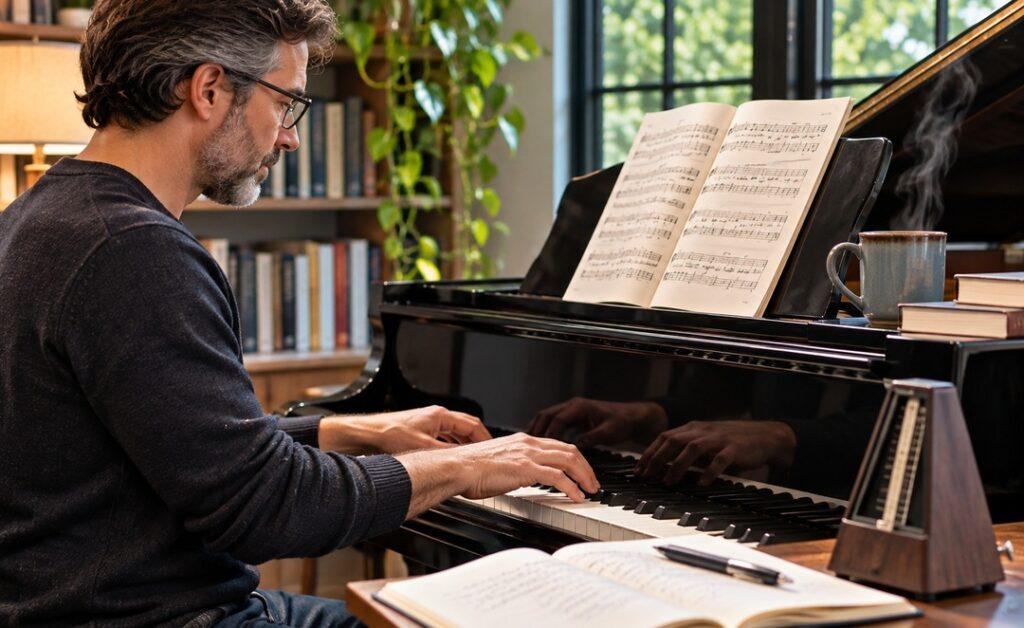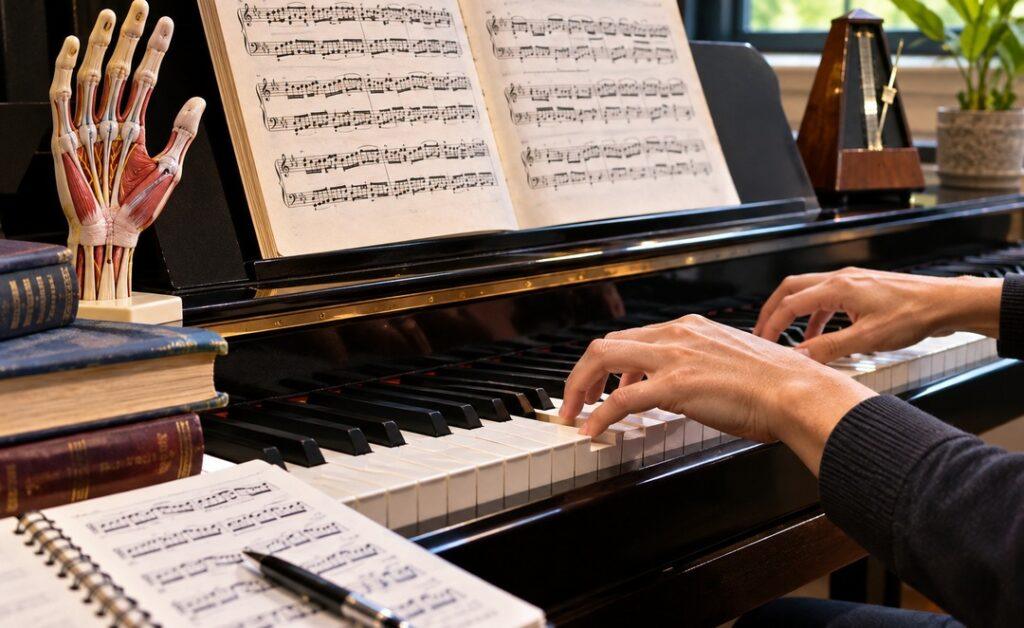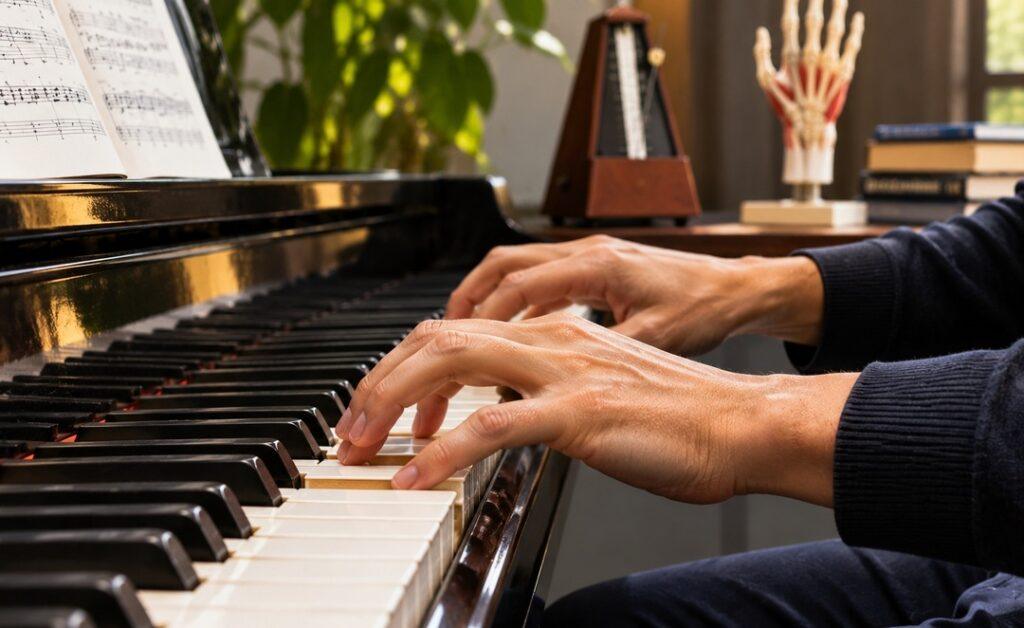


Adult pianists approaching modern keyboard education face an immediate mechanical dilemma that rarely confronted previous generations of musicians. Rather than learning exclusively on seasoned acoustic uprights or studio grand pianos, contemporary students increasingly build foundational technique across digital instruments, stage pianos, and hybrid MIDI controllers. While technological accessibility has democratized musical practice, it has simultaneously introduced subtle tactile challenges. Navigating keyboard resistance, escapement friction, and keybed travel requires conscious analytical focus, as highlighted in comprehensive technique tutorials published across Kay Granger Piano Lessons.
Understanding the physics of keyboard action is not a purely academic exercise for gear collectors; it directly dictates how the human hand develops neuromuscular control, prevents repetitive strain injuries, and produces expressive musical nuance. When an adult student attempts to articulate a delicate pianissimo or project a resonant fortissimo, the tactile resistance beneath their fingertips determines whether the musical intention translates accurately into tone or collapses into uneven dynamics. By dissecting the biomechanics of keystrikes, comparing mechanical action architectures, and establishing structured practice habits, adult pianists can bridge the gap between digital convenience and authentic concert-level touch.
The Biomechanics of Finger Articulation and Key Resistance
Every keystrike on a keyboard instrument represents a complex kinetic chain involving fingertip pads, lumbrical muscles, forearm flexors, wrist dampening, and upper-arm momentum. In acoustic pianos, pressing a key does not simply trip an electronic sensor; it initiates a lever motion that elevates a weighted felt hammer toward a tensioned steel string. This mechanical journey creates distinct tactile phases: initial inertia, keybed travel resistance, let-off or escapement friction, and final downward impact. Without adequate resistance, the hand cannot calibrate the kinetic energy required to depress the key smoothly.
When adult beginners practice on non-weighted or spring-tensioned plastic synthesizers, the keys push back with uniform, artificial velocity regardless of musical intention. Because spring mechanisms lack true gravitational momentum, students frequently compensate by tensing their wrists, flattening their knuckles, and hammering the keybed with brute force. Professional pedagogical frameworks documented by the Music Teachers National Association stress that early tactile feedback directly reinforces long-term motor memory. Without authentic key resistance, students fail to build intrinsic finger independence, leaving their playing brittle and mechanically inconsistent.
Conversely, appropriately weighted keybeds allow the player to utilize arm weight rather than localized muscular strain. By releasing the weight of the forearm through curved finger arches into the key descent, the pianist engages gravity to generate volume and color. This physiological economy of motion is essential for adult learners, whose tendons and joints exhibit less natural elasticity than those of developing young children. Mechanical resistance, far from being an obstacle to overcome, acts as a stabilizing physical partner that supports the hand during intricate passages.
Architectural Differences Across Modern Keybed Mechanisms
Digital piano manufacturers have spent decades engineering electro-mechanical action assemblies designed to replicate the acoustic grand experience. However, variations in lever pivot length, counterweight placement, and sensor geometry create drastically divergent playing experiences across modern price tiers. Understanding these engineering differences enables students to select instruments that genuinely reinforce sound technique.
| Keybed Action Type | Mechanical Architecture | Dynamic Feedback Level | Pedagogical Suitability |
| Spring-Loaded (Synth Action) | Coiled steel springs beneath plastic keys; no independent hammer levers | Linear resistance; lacks velocity inertia and tonal control | Synthesizer leads, organ glissandos; unsuitable for classical or acoustic repertoire |
| Semi-Weighted Action | Light spring tension paired with small metal counterweights | Moderate initial resistance; limited gradations across dynamic range | General keyboard rehearsal, portable pop accompaniment |
| Graded Hammer Action (GHA) | Independent swinging weighted hammers; heavier in bass, lighter in treble | Authentic gravitational inertia; realistic velocity sensing | Recommended minimum standard for foundational piano study |
| Hybrid Wood Lever Action | Full-length wooden keysticks with physical acoustic-style escapement mechanics | Indistinguishable from acoustic concert grand touch | Advanced collegiate practice, professional repertoire refinement |
The distinction between graded hammer action and lesser semi-weighted designs lies in the distribution of mass. In acoustic pianos, bass strings are substantially thicker and require heavier hammers to initiate vibration, resulting in noticeable downweight resistance in lower octaves. Higher treble keys employ smaller, lighter hammers. Graded digital actions mirror this acoustic phenomenon by calibrating individual hammer weights across four or five distinct keyboard zones. Research publications from the Journal of New Music Research indicate that physical hammer inertia is the single most critical variable determining whether a pianist can accurately modulate expressive timbre.
Furthermore, high-end digital and acoustic hybrid actions incorporate escapement simulation, often known as the “notch” or “let-off” sensation felt when pressing a key slowly toward its bed. In a grand piano, escapement allows the hammer to disengage from the key mechanism immediately before striking the string, preventing the hammer from blocking string resonance. This subtle mechanical detent provides critical tactile cues when performing delicate trills, rapid repetitions, and whispered cantabile melodies.

Establishing Touch Sensitivity and Expressive Control
Developing touch sensitivity requires deliberate, focused practice strategies that isolate mechanical resistance from pitch accuracy. Many adult students mistakenly believe that playing complex, fast literature is the primary marker of advancement. In reality, the true test of technique is the ability to produce a controlled, singing melodic line over a hushed harmonic accompaniment—a discipline known as dynamic voicing.
Voicing requires the hand to deliver two completely distinct energy levels simultaneously within the same chord. For instance, when a right hand plays a four-note harmony, the fifth finger must project the soprano melody with decisive velocity, while the thumb, index, and middle fingers depress lower harmony notes with muted restraint. Standardized examination syllabi published by the Associated Board of the Royal Schools of Music emphasize that dynamic control and tonal balance serve as foundational benchmarks across intermediate and advanced certification tiers.
To cultivate this refined tactile discrimination, adult pianists should implement targeted micro-exercises that cultivate awareness of key travel:
- Ghost Keystroke Practice: Slowly depressing keys down to the escapement point without generating an audible tone, training the finger flexors to gauge the exact threshold where mechanical resistance yields.
- Drop-and-Catch Arm Weight Drills: Releasing the natural weight of the forearm from a three-inch elevation into a single curved finger, allowing key resistance to absorb the descent without collapsing the wrist.
- Layered Chord Voicing Routines: Playing standard major and minor triads while consciously pressing the target melody note to the keybed twice as quickly as the secondary supporting tones.
- Staccato-to-Legato Articulation Pairs: Alternating crisp, fingertip-driven staccatos with smooth, overlapping legatos across simple five-finger patterns to master tone release timing.
These exercises systematically dismantle the habit of aggressive keystroking. By shifting the performer’s focus from finger muscularity to balanced gravity management, practice sessions become less physically exhausting and far more musically productive.
The Role of Acoustic Escapement in Contemporary Performance
As adult students progress into intermediate romantic and impressionistic literature—such as Chopin preludes or Debussy arabesques—the role of escapement becomes paramount. In instruments with responsive dual-escapement or high-density triple-sensor digital scanning, a pianist can restrike a note without fully releasing the key to its resting position. This capability allows for lightning-fast repeated notes and seamless, shimmering legatissimo textures that would be mechanically impossible on spring-based keyboards.
The historical evolution of this mechanism, extensively chronicled in keyboard design archives curated by the Smithsonian National Museum of American History, illustrates why Sébastien Érard’s 1821 double-escapement invention revolutionized 19th-century concert literature. By decoupling the repetition cycle from total key release, Érard liberated virtuosos like Franz Liszt to compose rapidly repeated octaves and intricate polyphonic textures. For the contemporary adult student, experiencing this mechanical responsiveness builds deep artistic confidence, transforming abstract musical notation into vibrant, physical reality.
Sustaining Healthy Technique in Lifelong Piano Study
The journey toward artistic fluency at the piano is a lifelong pursuit that rewards mindful patience over rushed mechanical drills. For adult learners balancing musical aspirations with professional and family commitments, cultivating an acute sensitivity to keyboard action is the ultimate safeguard against technical stagnation and physical discomfort. Practicing on an instrument that offers honest gravitational resistance teaches the nervous system to trust the mechanics of the keybed rather than forcing sound through excessive muscle tension.
By respecting the kinetic dialogue between human touch and keyboard action, adult pianists transform their daily study from a repetitive chore into a deeply rewarding tactile art. Whether exploring delicate classical nocturnes, modern cinematic soundtracks, or complex contemporary chords, the pianist who commands key resistance possesses the master key to expressive performance: the ability to make a machine of wood, felt, steel, and sensors sing with the authentic nuance of the human voice.