
Advancing past early beginner milestones is often one of the most intellectually rewarding yet technically precarious transitions in keyboard education. While early piano instruction focuses on fundamental literacy, steady pulse, and basic hand independence across static five-finger patterns, intermediate study demands an entirely different cognitive and physical architecture. Students confront complex polyphony, wider keyboard navigation, multi-voice voicing within a single hand, and nuanced pedal mechanics. As detailed across ongoing educational analyses in the Piano Lessons archive, overcoming intermediate plateaus requires moving away from mindless mechanical repetition toward deliberate, modular practice regimens that cultivate intentional listening and physiological efficiency.
A frequent trap for advancing pianists is treating practice time as mere playthrough rehearsal. Playing an intermediate piece—such as a Bach two-part invention, a Clementi sonatina, or a Chopin prelude—from beginning to end without focused structural intervention merely reinforces physical hesitation and technical inaccuracies. Modern pedagogical guidelines published by the Music Teachers National Association emphasize that technical growth occurs when practice sessions are divided into diagnostic intervals that isolate muscular fatigue, balance dynamic voicing, and calibrate tactile keyboard resistance.
Architectural Structure of an Effective 60-Minute Routine
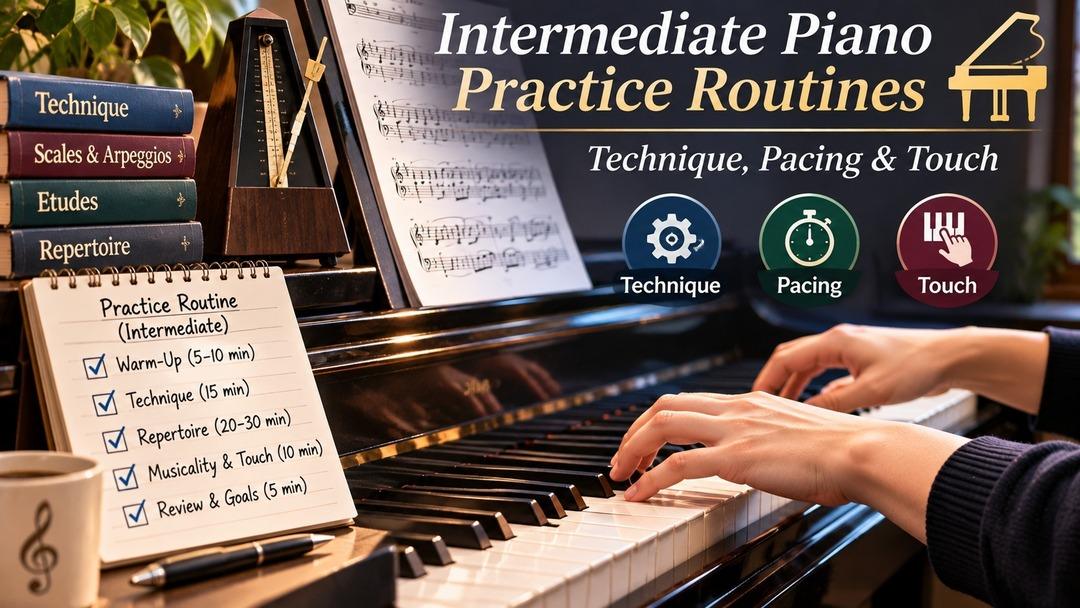
Intermediate practice demands a structured framework that respects mental concentration limits and neuromuscular recovery. Rather than dedicating an unstructured hour to whatever score sits on the music desk, serious students achieve vastly superior retention by employing a four-phase modular routine. This framework ensures foundational technique receives daily maintenance while preventing mental burnout during intense score study.
The first fifteen minutes belong to physiological warm-up and technical refinement. Pianists engage with symmetrical scales, arpeggios, and short technical etudes designed to stabilize the wrist and activate fingertip arches. The subsequent twenty-five minutes focus on primary, high-friction repertoire: newly assigned movements or mechanically dense phrases that require slow, analytical dissection. The remaining time shifts into maintenance of mature repertoire and sight-reading calibration, ensuring that previously mastered works remain concert-ready while musical literacy continues to sharpen.
| Session Phase | Time Allocation | Primary Focus Area | Core Pedagogical Objective |
| Warm-Up & Technique | 10–15 Minutes | Scales, arpeggios, Hanon or Czerny patterns | Arm weight distribution, flexible wrist circles, finger independence |
| Core Repertoire Study | 20–25 Minutes | Challenging phrase sections in current repertoire | Slow practice, rhythmic alternation, hands-separate analysis |
| Interpretive Voicing | 10–15 Minutes | Dynamic balancing, cantabile touch, pedal coordination | Separating melodic weight from accompaniment textures |
| Literacy & Review | 10 Minutes | Fresh sight-reading, ear training, polished repertoire | Visual pattern recognition, long-term memory consolidation |
Touch Calibration: Weight Transfer and Keybed Resistance
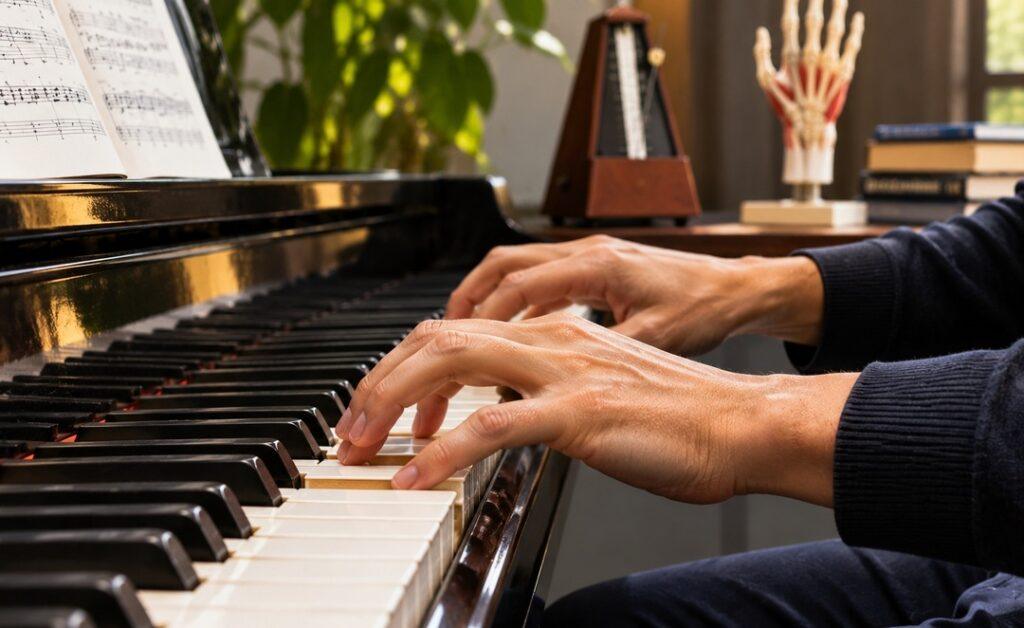
A defining hallmark of intermediate progression is the transition from finger-generated striking to gravity-assisted arm weight transfer. In elementary playing, novices frequently generate tone by pushing downward from the knuckle joints alone, creating excessive forearm tension and thin, brittle dynamics. High-level classical pedagogy, supported by historical treatises archived through the Royal Academy of Music, demonstrates that rich, resonant tone production requires a relaxed shoulder girdle, a supple wrist that acts as an organic shock absorber, and curved, firm finger cushions that channel natural arm weight into the keybed.
When practicing polyphonic works where a single hand must balance an upper cantabile melody above a quiet sixteenth-note accompaniment, students must calibrate weight distribution across the hand. Practicing the melodic line with a deep, deliberate arm drop while “ghosting”—silently depressing or lightly brushing the inner accompanying keys—trains the central nervous system to direct variable velocity into individual fingers. This tactile differentiation is essential for navigating classical sonata movements and romantic nocturnes with expressive maturity.
Overcoming Technical Plateaus Through Deliberate Interleaving
When pianists encounter complex passages, such as rapid scale runs, octave leaps, or wide-interval Alberti bass accompaniments, instinct often drives them to drill the problematic measure dozens of times consecutively. However, cognitive motor-learning research confirms that blocked drilling produces rapid short-term performance gains that rapidly deteriorate by the following day. To achieve permanent neural consolidation, intermediate practice routines must incorporate interleaved and variable practice methods.

Transforming mechanical passages into rhythmic variations forces the brain to reprogram motor timing. Students practicing intricate sixteenth-note figurations should alternate between dotted rhythms (long-short and short-long patterns), varied articulation groupings (two slurred, two staccato), and deliberate tempo pauses on specific weak beats. By changing the temporal relationship between keystrokes, the hand develops reflexive stabilization points that withstand performance anxiety and physical fatigue.
- Rhythmic Mutation: Alter standard meter into dotted eighth-sixteenth pairs to isolate sluggish finger transitions and strengthen weak fourth and fifth fingers.
- Backward Chaining: Begin learning complex phrases from the final measure and work backward toward the entry, ensuring the hand always travels toward familiar, confident terrain.
- Deliberate Slow-Motion Practice: Execute passages at half tempo without pedal, maintaining total awareness of finger release, thumb crossovers, and wrist rotation.
- Metronome Ladder Intervals: Build velocity gradually by advancing four metronome notches, dropping back two notches, and solidifying control before pushing speed thresholds.
Repertoire Pacing and Long-Term Artistic Growth
Artistic sustainability at the intermediate level depends on realistic repertoire curation. Students frequently attempt aspirational masterworks far beyond their current technical vocabulary, spending months wrestling with a single advanced piece while foundational reading skills stagnate. A balanced intermediate curriculum pairs one demanding “reach” piece with two accessible, contemporaneous works from contrasting stylistic eras—such as balancing a classical Haydn sonata movement with a lyrical Romantic character piece and a 20th-century Bartók study.
By rotating diverse musical styles through structured practice windows, pianists develop versatile stylistic touch, keen harmonic perception, and genuine musical self-awareness. Daily practice ceases to be a chore of mechanical endurance; instead, it becomes a creative workshop where technical discipline serves artistic expression, laying a durable foundation for advanced musicianship.